
Key Takeaways
- AI-powered HRMS software automates repetitive HR work like payroll, attendance, and compliance while surfacing insights managers can actually act on.
- The difference between HRMS and HRIS comes down to scope: HRIS stores workforce data, while HRMS adds workflow automation and increasingly, AI-driven decision support.
- Indian businesses face specific pressures around statutory compliance, multi-state payroll, and hybrid teams that AI features are well suited to handle.
- Small and mid-sized companies often see the fastest returns because they lack large HR teams to absorb manual work.
- Wings Office offers an integrated approach that connects HR, payroll, and workforce analytics in one system.
Picture an HR manager at a growing company in Pune spending the last week of every month reconciling attendance logs, chasing leave approvals, and manually calculating PF and TDS deductions across three states. That routine is exactly what AI-powered HRMS software in India is built to dismantle. Instead of treating HR as a data-entry function, modern systems automate the grunt work and hand people time back for the parts of the job that need judgment.
This piece explains what AI HRMS software actually does, how it differs from older HRIS systems, why it fits Indian businesses in particular, and where the technology is heading. Wings Office sits in this conversation as a platform built around that shift, and we’ll look at where it fits along the way.
What AI HRMS Software Really Means
At its core, an HRMS (Human Resource Management System) is the software backbone that runs employee-facing operations: recruitment, onboarding, attendance, leave, payroll, and exits. The “AI-powered” part refers to a layer of automation and prediction sitting on top of that backbone. Rather than just storing records and running rules you define, the system learns from patterns in your workforce data and makes suggestions or takes routine actions on its own.
The distinction matters. A traditional HRMS will process leave requests according to a policy you configure. An AI-enhanced one might flag that a particular team’s leave clustering every quarter-end correlates with burnout or auto-classify a resume against a job description without a recruiter reading all 200 applications first. The intelligence is applied, practical, and tied to outcomes, not a chatbot bolted onto a login screen.
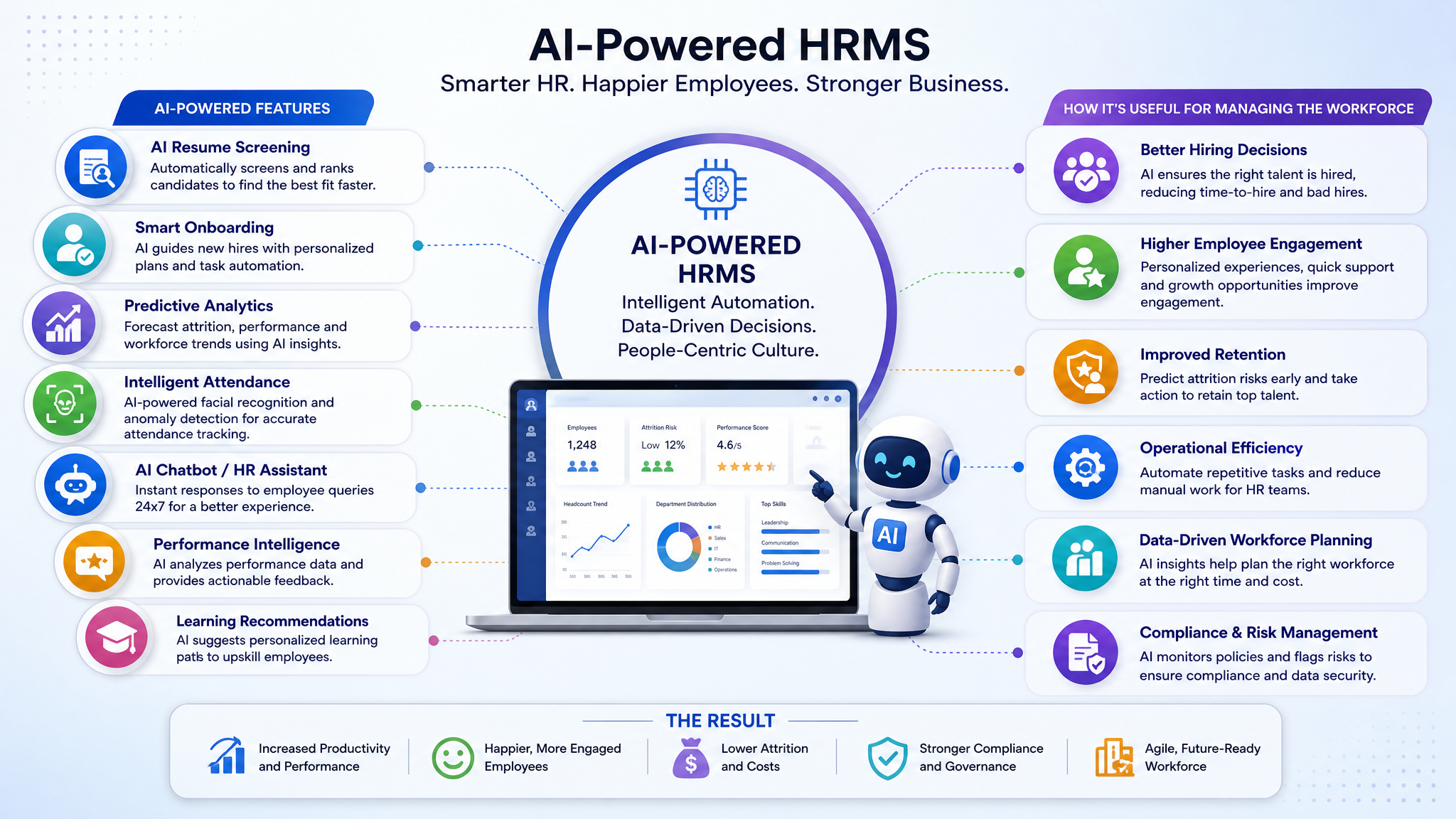
Most credible AI HRMS platforms today include a recognizable set of capabilities:
- Automated payroll and compliance processing that calculates statutory deductions, generates payslips, and files returns while adapting to changes in tax slabs or state-specific rules.
- Attendance and shift management using biometric, geo-tagged, or app-based check-ins, with anomaly detection that flags unusual patterns instead of waiting for a manager to notice.
- Predictive analytics for attrition, which reads signals like engagement scores, tenure, and compensation gaps to estimate flight risk before an employee resigns.
- Resume screening and candidate matching that ranks applicants against role requirements, cutting the time recruiters spend on early-stage filtering.
- Employee self-service and conversational support, where staff can check balances, apply for leave, or resolve routine HR queries without opening a ticket.
Not every feature earns its keep for every company. A ten-person startup rarely needs attrition modeling, but it may benefit enormously from automated payroll. The value comes from matching capabilities to your actual pain, not adopting the full suite because it exists.
How AI-Powered HRMS Software Changes Day-to-Day HR Operations
The clearest way to understand the impact is to follow a single process end to end. Take payroll, the part of HR most likely to cause errors and the one employees are least forgiving about.
In a manual or lightly automated setup, HRMs and Payroll live in separate spreadsheets or loosely connected tools. Someone exports attendance, adjusts for approved leave, calculates gross pay, layers in deductions, checks statutory limits, and finally releases salaries. Each handoff is a place for mistakes. An AI-driven system collapses that chain: attendance feeds directly into payroll, deductions apply automatically against current rules, and the system flags outliers, say, an employee whose net pay dropped sharply, before the run is finalized.
Onboarding is another area where the operational gain is tangible. Instead of an HR coordinator emailing forms, chasing signatures, and manually creating accounts, the system triggers a sequenced workflow the moment an offer is accepted. Documents get collected, verified, and stored; provisioning tasks route to IT; and the new hire lands on day one with everything ready. The HR team steps in only when something needs a human decision.
What ties these together is that automation removes the invisible tax of coordination. HR professionals spend a surprising share of their week simply moving information from one place to another. Take that away and the same team can support more employees without growing headcount, which is precisely why smaller businesses tend to feel the benefit first.

HRMS vs. HRIS: What’s Actually Different
These terms get used interchangeably, and vendors don’t help by blurring the line. The practical difference is scope and intent.
| Aspect | HRIS | HRMS |
|---|---|---|
| Primary purpose | Storing and managing core employee data | Managing end-to-end HR processes and workflows |
| Typical scope | Records, org structure, basic reporting | Payroll, attendance, performance, recruitment, and records |
| Automation level | Limited; mostly a database with forms | Extensive; workflows, approvals, and increasingly AI-driven actions |
| Decision support | Descriptive reporting on past data | Predictive insights like attrition risk and workforce planning |
| Best suited for | Organizations needing a reliable system of record | Organizations wanting to automate operations and act on insights |
The short version: an HRIS answers “what is our workforce data?” while an HRMS answers “what should we do about it?” Once AI enters the picture, the gap widens further, because prediction and automation are firmly HRMS territory. If you’re evaluating tools and a vendor calls the same product both, ask specifically which processes it automates end-to-end. That answer tells you where the product really sits.
Why AI HRMS Software Fits Indian Businesses So Well
India’s HR environment carries complexity that generic global tools often handle poorly. Statutory compliance alone involves EPF, ESI, professional tax that varies by state, TDS, and periodic changes to labor codes. A company operating across Maharashtra, Karnataka, and Tamil Nadu is effectively running three different compliance regimes at once. Manual handling here isn’t just slow; it’s a genuine risk, because a missed filing or miscalculated deduction invites penalties.
An AI HRMS built for the Indian market treats this as a first-class problem. Compliance logic updates centrally, state-specific rules apply automatically based on employee location, and the system maintains an audit trail without anyone assembling one by hand. For a finance or HR head, that shifts compliance from a recurring fire drill to a background process.
Hybrid and distributed work adds another layer. Since teams became comfortable working from home offices, tier-two cities, and client sites, attendance and productivity became harder to track fairly. App-based check-ins with location context, paired with anomaly detection, give managers visibility without turning into surveillance, provided the policy around it is transparent. That balance matters, and it’s worth being honest that badly implemented monitoring erodes trust faster than any tool can rebuild it.
There’s also a talent dimension. Attrition in Indian tech and services sectors runs high, and replacing an employee costs far more than most balance sheets show once you count lost productivity and rehiring. Predictive attrition signals give managers a window to intervene, though the caveat is important: the model points to risk, it doesn’t diagnose the cause. A good HR team uses the flag as a prompt for a conversation, not as a verdict.
Why HRMs Software for SMEs Delivers the Fastest Returns
Large enterprises have the budget to absorb inefficiency. They can staff HR teams generously and paper over manual processes with more people. Smaller and mid-sized companies don’t have that cushion, which is exactly why HRMs software for SMEs tends to produce visible results quickly.
Consider a hypothetical services firm with 80 employees and a two-person HR team. Before automation, month-end payroll consumes most of a week, onboarding is inconsistent, and leave tracking lives in a shared sheet nobody fully trusts. Introduce an integrated system and those two people reclaim the equivalent of several days each month. That reclaimed time doesn’t vanish into slack; it goes toward hiring, retention, and the culture work that actually moves a growing business.
The economics are favorable for smaller teams in a way that isn’t always true at enterprise scale. Cloud-based HRMs software for small businesses removes upfront infrastructure cost, scales with headcount rather than demanding a big commitment, and puts capabilities like predictive analytics within reach of companies that could never have built them in-house. What was once an enterprise-only luxury is now a subscription line item.
Where does Wings Office fit? Its approach centers on connecting HR, payroll, and workforce analytics in a single system rather than stitching together separate tools, which is often the biggest source of friction for growing companies. For a business that wants HRMs and Payroll working from the same source of truth, an integrated platform removes the reconciliation headaches that plague multi-tool setups.
Where AI HRMS Software in India Is Headed
The trajectory over the next few years points toward HR systems that shift from reactive to genuinely advisory. Today’s tools mostly automate what you tell them to. The direction of travel is systems that surface recommendations proactively: which roles to prioritize hiring for based on project pipeline, where pay bands have drifted out of market range, or which managers’ teams show early engagement decline.
Conversational interfaces will keep improving, letting employees interact with HR systems in natural language across regional languages, which matters enormously in a country with India’s linguistic diversity. Skills-based workforce planning is another area gaining ground, where the system maps existing capabilities against future needs and suggests training paths rather than defaulting to external hiring.
A word of realism, though. AI in HR touches sensitive territory: pay, performance, and employment decisions. As these systems grow more capable, questions around bias in algorithmic screening, data privacy under evolving Indian regulation, and the right level of human oversight will get sharper, not softer. The businesses that benefit most will be the ones that treat AI as decision support with a human firmly in the loop, not as an autopilot for people decisions. Technology maturity and organizational maturity have to advance together.
For companies weighing the move now, the question isn’t whether AI-powered HR tooling becomes standard; it’s how prepared your processes and data are to make good use of it. Clean data, clear policies, and a team ready to act on insight matter more than the sophistication of any single feature.
Frequently Asked Questions
Is AI HRMS software only worth it for large companies?
No. Smaller and mid-sized businesses often see returns faster because they lack the large HR teams that mask manual inefficiency. Cloud-based pricing that scales with headcount also makes advanced features accessible without high upfront cost.
What is the difference between HRMS and HRIS?
An HRIS focuses on storing and managing core employee data as a system of record, while an HRMS manages end-to-end HR processes like payroll, attendance, and performance. AI capabilities such as predictive analytics sit firmly on the HRMS side.
Can AI HRMS software handle India-specific compliance?
Platforms built for the Indian market handle EPF, ESI, state-wise professional tax, and TDS, applying the correct rules based on employee location and updating centrally when regulations change. This reduces the compliance risk that comes with manual, multi-state processing.
Does AI in HRMS replace HR professionals?
It automates repetitive work and surfaces insights, but people’s decisions still need human judgment. Predictive signals like attrition risk are prompts for a conversation, not verdicts, so HR teams remain central to interpreting and acting on what the system flags.