
Key Takeaways
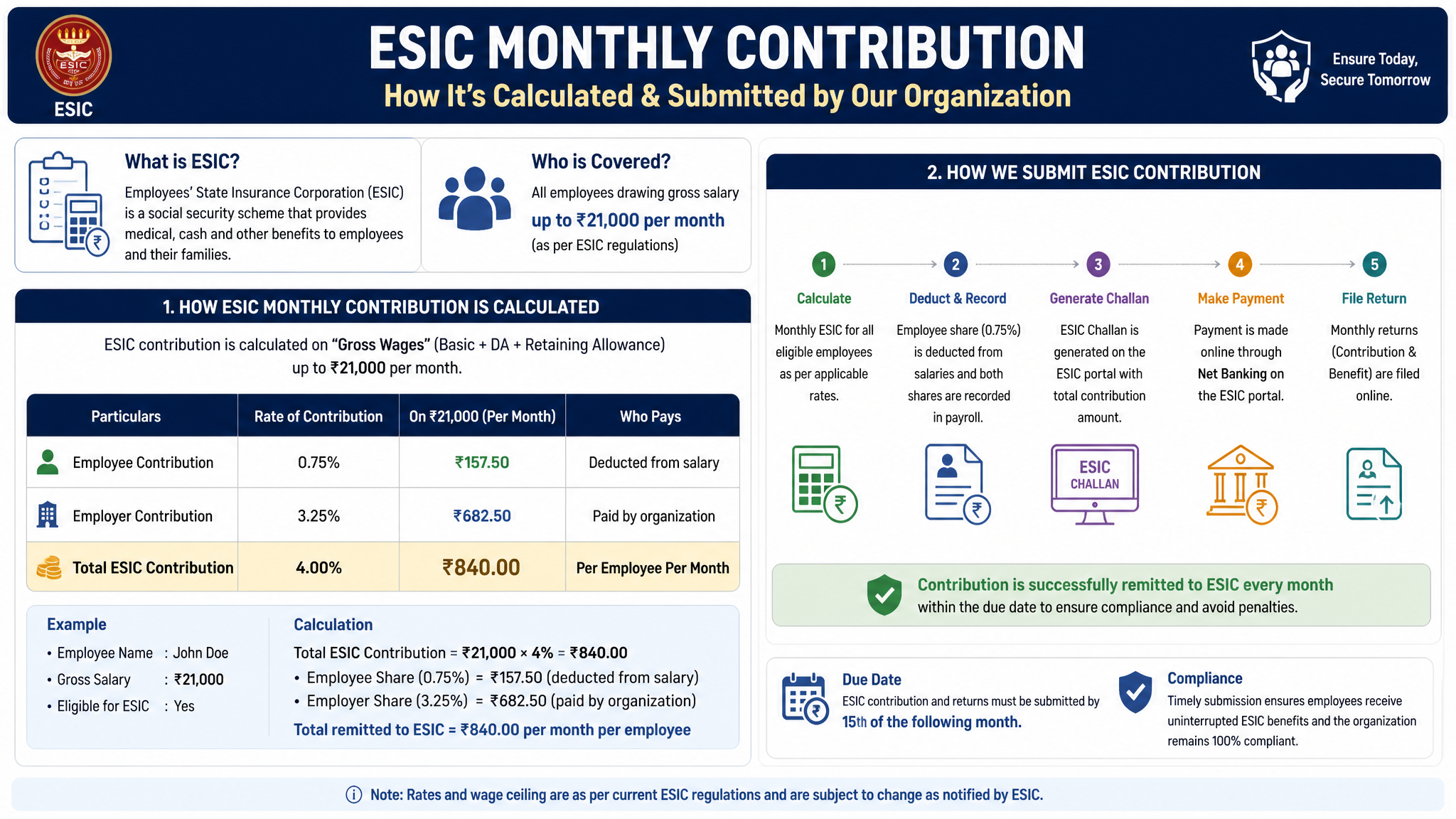
- The ESIC monthly contribution is due by the 15th of the following month, with employers contributing 3.25% and employees 0.75% of wages.
- Filing happens entirely online through the ESIC employer portal, where you upload wage details, generate a challan, and pay through net banking.
- ESIC covers six broad categories of benefits, including medical, sickness, maternity, disablement, dependant, and funeral support.
- There is no government filing fee for ESIC returns; the only cost is the contribution itself, though professionals may charge a service fee.
- The contribution period runs in two fixed cycles of six months each, which determines the benefit period for employees.
Missing the 15th of the month by a single day can trigger interest and damages on your ESIC dues, and those penalties stack whether you forgot or simply got the wage calculation wrong. For any employer covered under the scheme, filing the ESIC monthly contribution correctly is not optional paperwork. It is a compliance obligation tied directly to your employees’ access to medical care and cash benefits. This guide walks through the full process, from understanding what the contribution actually is to generating and paying the challan on the ESIC portal.
What the ESIC Monthly Contribution Actually Covers
The Employees’ State Insurance Corporation runs a social security scheme for workers earning up to a defined wage ceiling, currently ₹21,000 per month (₹25,000 for employees with disabilities). If your establishment employs ten or more people and falls under the ESI Act, you are required to register and contribute every month.
The contribution is split between two parties. As of the current rates, employers pay 3.25% of an employee’s gross wages, and employees pay 0.75%. So for someone earning ₹15,000 a month, the employer puts in ₹487.50 and the employee ₹112.50, for a combined monthly contribution of ₹600. You, as the employer, deduct the employee’s share from their salary and deposit the total amount.
One point that trips up new employers: once an employee’s wages cross the ceiling mid-contribution period, they continue to contribute until that period ends rather than dropping out immediately. This is where ESIC contribution for employers gets procedural, and getting it wrong means either over-deducting or leaving a gap that surfaces during an inspection.
How Many Benefits ESIC Provides
The reason the scheme exists is the benefit package your contributions fund. ESIC organizes these into six broad categories, and understanding them helps when employees ask what they are actually paying for.
- Medical benefit gives the insured person and their family full medical care from the day of employment, with no cap on treatment expenditure for the employee and dependants.
- Sickness benefit pays cash at around 70% of wages during certified sickness for up to 91 days in a year, provided contribution conditions are met.
- Maternity benefit provides paid leave for confinement, currently extending to 26 weeks, along with additional provisions for miscarriage or illness arising from pregnancy.
- Disablement benefit covers both temporary and permanent disablement from employment injury, paid monthly as long as the disability continues.
- Dependants’ benefit supports the family with a monthly payment if the insured person dies due to an employment injury or occupational hazard.
- Funeral and other benefits include a funeral expense payment and smaller provisions like confinement expenses where medical facilities are unavailable.
These benefits are the practical argument for timely filing. A delayed or missed contribution can interrupt an employee’s eligibility at the exact moment they need coverage, which is a reputational problem for you well beyond the compliance penalty.
Filing Fees for PF and ESIC Returns
A common question from first-time employers is what it costs to file. The direct answer: the government charges no filing fee for submitting your ESIC monthly contribution or your Provident Fund returns. What you pay is the contribution amount itself, nothing more on the statutory side.
The confusion usually comes from service charges. If you hand compliance to a consultant, payroll firm, or chartered accountant, they will charge a professional fee for handling both PF and ESIC filings on your behalf. That fee varies widely based on your headcount and how many services you bundle, so there is no fixed rate to quote. For a small establishment doing filings in-house, the cost is effectively zero beyond staff time and the contribution.
Where real money enters the picture is late payment. Delayed ESIC contributions attract simple interest at 12% per annum for each day of delay, plus damages that scale with how long the delay runs. The same discipline applies to PF. So the actual cost of filing is not the fee, it is the penalty for getting the timing wrong.

How to File the ESIC Monthly Contribution Step by Step
The entire process runs through the ESIC employer portal, and once you have done it twice it becomes routine. Here is the sequence that works for most employers.
Log in to the employer portal. Go to the ESIC website and sign in with your 17-digit employer code and password. If you have not registered your establishment yet, that registration has to happen before any contribution filing is possible.
Open the monthly contribution section. From the dashboard, select the option to file the monthly contribution for the relevant month. The portal pulls up your list of registered employees, or Insured Persons, for that period.
Enter or upload wage details. For each employee, you enter the number of days worked and the wages paid. If you run a larger workforce, download the Excel template, fill in the data offline, and upload it in bulk rather than keying in each line. The system then calculates the contribution automatically based on current rates.
Verify the computed contribution. Check that the total matches your own payroll figure before proceeding. Discrepancies here are almost always wage-entry errors, and catching them now is far easier than filing a revision later.
Submit and generate the challan. Once you confirm the records, submit the contribution. The portal generates a challan with a unique number tied to that month’s filing.
Make the payment. Proceed to the online payment gateway, choose your bank, and pay through net banking. The challan status updates to paid once the transaction clears, and that confirmation is your proof of compliance.
Sound ESIC monthly contribution management is really just repeating this loop reliably every month, with the wage data reconciled against your payroll before submission.
How to Download the ESIC Monthly Contribution Challan
Employers frequently need the challan after filing, whether for their own records, an audit, or to prove payment during an inspection. Downloading it is straightforward.
Log back into the employer portal and look for the option labelled something like “Generate Challan” or “List of Challans” in the monthly contribution menu. Select the month and year you need, and the system displays the challan records for that period. You can view the challan, check its payment status, and download or print it as a PDF.
If you generated a challan but have not yet paid, the same screen lets you resume the payment. If payment is already complete, the downloaded copy shows the transaction reference, which is what you keep on file. Keep a dated folder of every monthly challan; during an ESIC inspection, being able to produce twelve clean challans for the year ends most queries before they start.
Understanding the ESIC Contribution Period
The ESI Act runs on two fixed six-month contribution periods, and this timing matters because it directly determines when your employees can claim cash benefits.
| Contribution period | Corresponding benefit period |
|---|---|
| 1 April to 30 September | 1 January to 30 June of the following year |
| 1 October to 31 March | 1 July to 31 December |
The gap between the two is deliberate. Contributions made in one six-month window fund the benefits an employee can draw in the matching benefit period later. This is also why an employee who crosses the wage ceiling must keep contributing until the end of the running contribution period rather than stopping mid-cycle; their benefit eligibility for the paired period depends on it.
For you as the employer, the monthly filing deadline stays the same regardless of which period you are in: the 15th of the month following the wage month. The contribution period framework is about benefit calculation, not your filing schedule, but knowing both prevents the confusion that leads to incorrect deductions.
Common Mistakes That Lead to Penalties
A few errors show up repeatedly, and all of them are avoidable. The most frequent is treating the 15th as a soft deadline. It is not; interest begins accruing from day one of delay. Another is misclassifying wages, for instance leaving out components that count as wages under the Act, which understates the contribution and surfaces as a liability during audit.
Employers also stumble on the exit side. When an employee leaves, their record needs to be updated so you are not filing contributions for someone no longer on payroll, and so their own ESIC status is accurate. And a surprising number of establishments file but forget to actually complete the payment, leaving a generated-but-unpaid challan that counts as non-compliance despite the filing being done.
Getting ESIC contribution for employers right is less about complexity and more about consistency. The rules are stable; the failures almost always come from missed deadlines or sloppy wage data.
Frequently Asked Questions
What is the due date to file the ESIC monthly contribution?
The contribution must be deposited by the 15th of the month following the wage month. For example, contributions for June wages are due by 15 July. Missing this date triggers interest at 12% per annum plus damages for the delay.
No. ESIC filing and payment are fully online through the employer portal. You enter or bulk-upload wage data, generate the challan, and pay via net banking, so there is no offline or paper submission route.
No. ESIC filing and payment are fully online through the employer portal. You enter or bulk-upload wage data, generate the challan, and pay via net banking, so there is no offline or paper submission route.
What happens if I miss an employee in the monthly filing?
You can file a supplementary challan for the omitted employee for that period, but it may attract interest if filed after the due date. It also risks interrupting that employee’s benefit eligibility, so reconcile your full employee list before submitting.
Is there any filing fee charged by the government for ESIC returns?
No, the government does not charge a filing fee for ESIC returns. You only pay the contribution amount. Any additional cost comes from professional service charges if you outsource the filing, or from penalties if you pay late.
Filing the ESIC monthly contribution is a monthly rhythm, not a one-time task, and the employers who stay compliant are simply the ones who treat the 15th as immovable and keep their wage data clean. If managing this alongside payroll, PF, and the rest of your compliance calendar is pulling your team away from actual work, Wings Office handles ESIC and PF filings end to end so your deadlines are met without the scramble. Reach out to set up a compliance process you can stop worrying about.