
Choosing payroll software in India isn’t really a software problem. It’s a compliance problem wearing a software costume. Between PF, ESI, professional tax that changes by state, TDS deductions, and gratuity calculations, the actual math is where most businesses trip up. The tool you pick either handles that mess automatically or hands it back to your accountant every month.
So instead of ranking these five options by feature count, this guide looks at what each one actually solves and who it fits. If you run a 12-person startup, your needs look nothing like a 400-employee manufacturing firm, and the “best” tool shifts accordingly.
What to Actually Check Before You Shortlist
Feature lists all look identical on a comparison page. Everyone claims automated payroll, statutory compliance, and self-service portals. The differences show up in the details you can’t see from a landing page.
A few things worth pinning down before you commit:
- Statutory coverage depth, meaning whether the tool auto-updates PF, ESI, and professional tax slabs when the government revises them, versus expecting you to patch the rates manually every time a state changes its rules.
- Multi-state handling, which matters the moment you hire someone in a second state, because professional tax and labour welfare fund rules differ enough that a tool built for one state creates errors in another.
- Integration with attendance and leave, since payroll built on wrong attendance data is just a faster way to pay people incorrectly, and disconnected systems force manual reconciliation every cycle.100-to-500-person
- Support responsiveness during filing deadlines, because a payroll issue on the 6th of the month, right before PF is due, needs a real human answer within hours, not a ticket queue.
Keep these four in mind as you read. They separate tools that look good in a demo from tools that survive month twelve.
Why Payroll Software in India Needs Different Priorities Than Global Tools
Global payroll platforms are excellent at what they do, but Indian statutory compliance is its own universe. A tool built primarily for US or European payroll often bolts on Indian compliance as a regional add-on, and that’s where gaps appear. Professional tax alone varies across states with different slabs and filing frequencies. ESI applies only below a wage threshold. Gratuity kicks in after five years. Form 16 generation has its own quirks.
This is the core reason locally-built payroll software in India tends to serve small and mid-sized companies better than repurposed international suites. The compliance logic is native, not translated. When the budget revises a TDS provision, a domestic vendor typically ships the update before your accountant even asks about it.
That said, if you’re a company with significant overseas headcount, a global platform with strong Indian support may still win. Match the tool to where your people actually are.

The Top 5 Payroll Software Worth Considering
Here’s the shortlist, with honest notes on who each one suits. Pricing changes frequently and depends on headcount and modules, so confirm current numbers directly with each vendor rather than trusting any figure you read online.
| Software | Best suited for | Standout strength |
|---|---|---|
| Wings Office | Growing SMBs wanting payroll inside a full HR and accounting suite | Unified back-office, not just payroll in isolation |
| RazorpayX Payroll | Startups wanting automated compliance with minimal setup | Auto-filing of PF, ESI, TDS |
| Zoho Payroll | Businesses already using the Zoho ecosystem | Deep integration with Zoho Books and People |
| GreytHR | Mid-sized firms needing detailed compliance and HR workflows | Mature statutory engine and reporting |
| Keka | Companies prioritising employee experience and analytics | Modern interface with strong self-service |
1. Wings Office
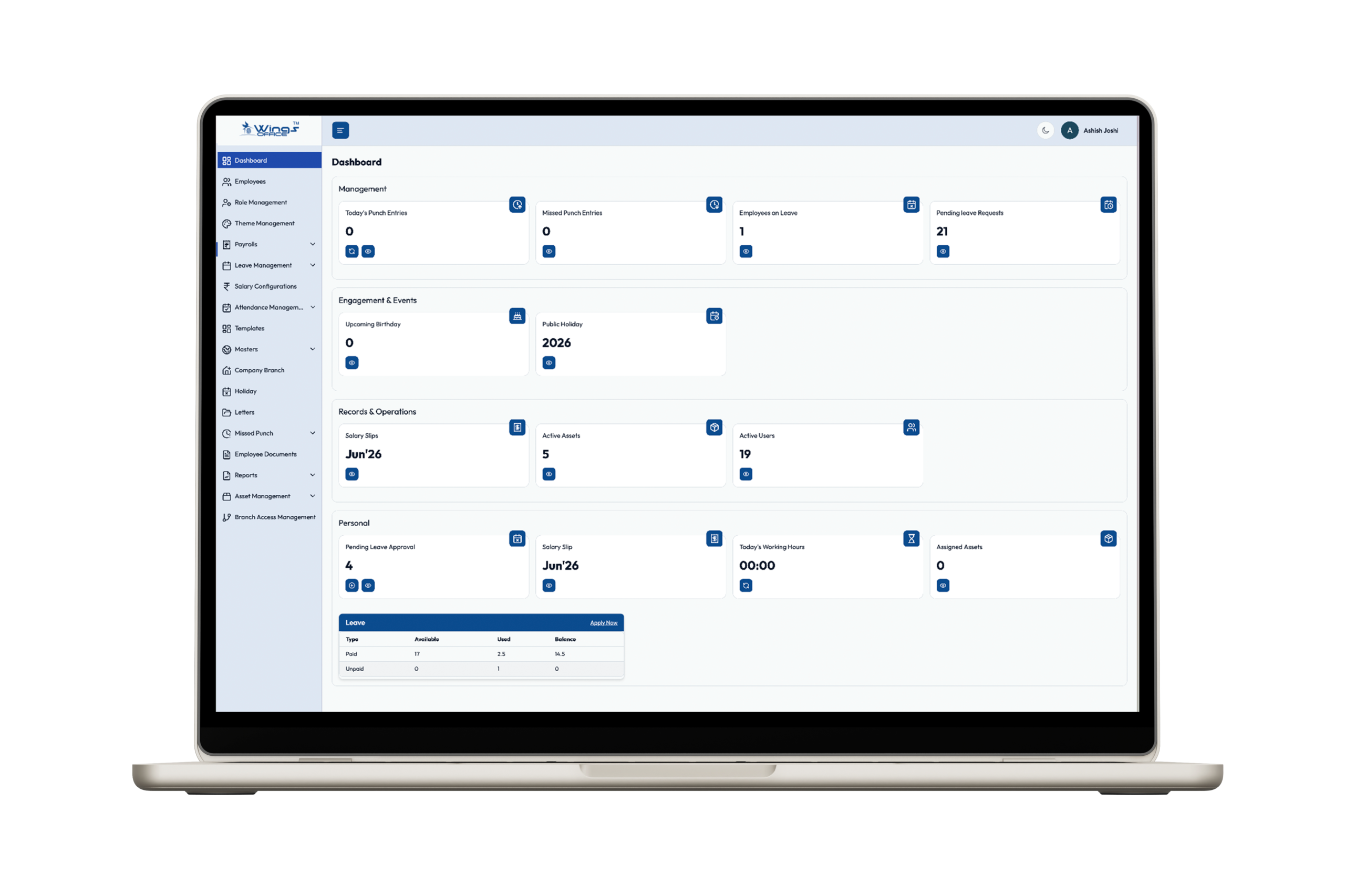
Wings Office approaches payroll as one part of a connected back office rather than a standalone module. That distinction matters more than it sounds. When payroll, accounting, and HR live in separate tools, month-end becomes a reconciliation exercise: exporting salary data, reformatting it, importing it into your accounting system, and hoping nothing broke in transit.
By keeping payroll linked to the ledger and to employee records in one system, Wings Office removes that handoff. Salary journals post directly, statutory deductions flow into the right accounts, and you’re not maintaining employee data in two places. For a business owner who wants fewer tools and fewer sync errors, that consolidation is the real value.
It fits companies that have outgrown spreadsheets and want a single platform for finance and workforce operations, without stitching together three separate subscriptions.
2. RazorpayX Payroll
RazorpayX built its payroll product around automation of the annoying parts. It calculates PF, ESI, and TDS, then handles the filings and payments with limited manual involvement. For a founder who’d rather not think about statutory deadlines, that hands-off compliance is the draw.
It suits early-stage and small teams especially well, where the priority is running payroll correctly without hiring a dedicated payroll person. The setup is quick and the interface stays out of your way. Where it’s less of a fit is highly complex, multi-state operations with unusual compensation structures, where you may want more configuration control.
3. Zoho Payroll
If your business already lives inside Zoho, adding Zoho Payroll is close to a default choice. It connects natively with Zoho Books for accounting and Zoho People for HR, so data moves between them without exports. That ecosystem lock-in is a genuine advantage when you’re already committed.
Its compliance handling covers the standard Indian requirements well, and the reporting is clean. The honest caveat: if you don’t otherwise use Zoho products, the integration benefit disappears, and you’re evaluating it purely on payroll merit against tools that may fit your existing stack better.
4. GreytHR
GreytHR has been in the Indian payroll space long enough to have a deep, mature statutory engine. It handles detailed compliance scenarios and produces the kind of granular reports that a finance controller at a mid-sized firm actually needs. Where newer tools optimise for simplicity, GreytHR optimises for thoroughness.
That thoroughness comes with a steeper learning curve. Smaller teams sometimes find it more elaborate than they need. But for a 100-to-500 person company with genuine compliance complexity across locations, that depth is exactly the point.
5. Keka
Keka leans hard into employee experience and analytics. The interface feels modern, self-service is strong, and employees can access payslips, tax declarations, and leave without pinging HR every time. For companies where retention and workforce experience are strategic priorities, that polish translates into fewer HR interruptions.
It handles core Indian payroll compliance competently, and its analytics give HR leaders useful visibility into workforce costs. It’s a strong pick for growing tech and services firms that treat their HR tooling as part of their employer brand.
Choosing Payroll Software for Small Businesses Without Overbuying
The most common mistake small companies make is buying for the company they imagine becoming rather than the company they are. When you’re evaluating payroll software for small businesses, the enterprise-grade compliance engine with fifty configuration options is impressive in a demo and exhausting in practice. You end up paying for depth you never use and spending onboarding time on features irrelevant to a 15-person team.
Match the tool to your actual constraints:
- If compliance anxiety is your main pain, prioritise automated filing and rate updates over reporting depth, since you want the statutory work to disappear rather than to be extensively configurable.
– - If your finance and payroll data keep drifting apart, prioritise a tool that unifies accounting and payroll, because the time lost to monthly reconciliation is a hidden cost most owners underestimate until it compounds.
- If compliance anxiety is your main pain, prioritise automated filing and rate updates over reporting depth, since you want the statutory work to disappear rather than to be extensively configurable.
- If you’re planning to double headcount within a year, check how pricing and complexity scale, because switching payroll systems mid-growth is painful and error-prone in a way that justifies planning ahead.
The Real Cost Isn’t the Subscription
Payroll software pricing gets most of the attention during evaluation, but the subscription is rarely where the money goes. The larger costs hide elsewhere: the hours your team spends on manual corrections, the penalties from a late or wrong statutory filing, and the switching cost if you pick wrong and migrate a year later.
A cheaper tool that produces filing errors or forces monthly manual reconciliation costs more than a pricier one that runs clean. When you compare options, weigh the total operational load, not just the per-employee monthly rate. The right question isn’t “what does this cost,” it’s “how many hours and how much compliance risk does this remove.”
That framing usually points toward consolidation. Every additional disconnected system adds a sync point, and every sync point is a place where data breaks. Fewer, better-integrated tools tend to win on total cost even when their sticker price looks higher.
Frequently Asked Questions
Is cloud-based payroll software safe for sensitive salary and tax data in India?
How long does it take to switch payroll software mid-year?
Can payroll software handle employees across multiple Indian states?
Do small businesses really need payroll software, or is a spreadsheet enough?
The strongest choice depends less on which tool tops a ranking and more on where your actual friction sits. If statutory deadlines keep you up at night, weight compliance automation. If your finance and payroll data never quite agree, weight integration. And if you’d rather manage one connected system than juggle three, that’s worth naming as a priority before you sign anything.
If a unified back office where payroll, accounting, and HR share the same data sounds like the friction you’re trying to remove, it’s worth seeing how Wings Office handles a full cycle for a team your size before you decide.