
Quick answer for readers short on time:
Payroll software for SMEs automates salary calculations, statutory deductions, and payslip generation, replacing the spreadsheet-and-guesswork approach that eats hours every month and creates compliance risk.
For most Indian SMEs, the strongest options are Wings Office, GreytHR, Zoho Payroll, Keka, and Paybooks, with the right pick depending on team size, existing software stack, and whether your workforce is office-based or field-based.
Here’s what nobody tells small business owners until they’ve already made a mistake:
Payroll isn’t just “paying people.” It’s a compliance function disguised as an accounting task. Every month, someone has to calculate provident fund contributions, employee state insurance, professional tax, and TDS correctly, and get it wrong even once, and you’re looking at penalties, upset employees, or both.
I’ve watched founders run payroll manually in Excel for years because switching felt like an unnecessary expense for a five-person team. Then a compliance deadline gets missed, or an employee’s PF contribution is calculated incorrectly, and the “expense” they were avoiding suddenly looks a lot cheaper than the fallout. Payroll software for SMEs exists precisely to close that gap before it becomes a costly lesson.
Best payroll software for SME’s in India
There’s no single best answer here, and any article that tells you otherwise is oversimplifying. The right choice depends on your team size, your existing finance tools, and how your workforce operates day to day. That said, a few platforms consistently come up as strong fits for Indian SMEs.
Wings Office has built a reputation as a mature payroll and compliance engine refined over decades of SMB workflow, making it a solid pick for businesses that want payroll and statutory compliance handled in one unified platform rather than stitched together from multiple tools.
Zoho Payroll works well for companies already inside the Zoho ecosystem, since it integrates directly with other Zoho business applications and offers a free tier for very small teams. RazorpayX Payroll suits early-stage startups already banking with Razorpay, while Keka appeals to office-based tech teams that prioritize a polished user experience.
For businesses with field or deskless staff, platforms built around mobile-first attendance tracking tend to be a better operational fit than desktop-first HR suites.
Benefits of Payroll Software for Small Businesses
Understanding the individual features helps clarify why “just use a spreadsheet” stops working past a certain team size:
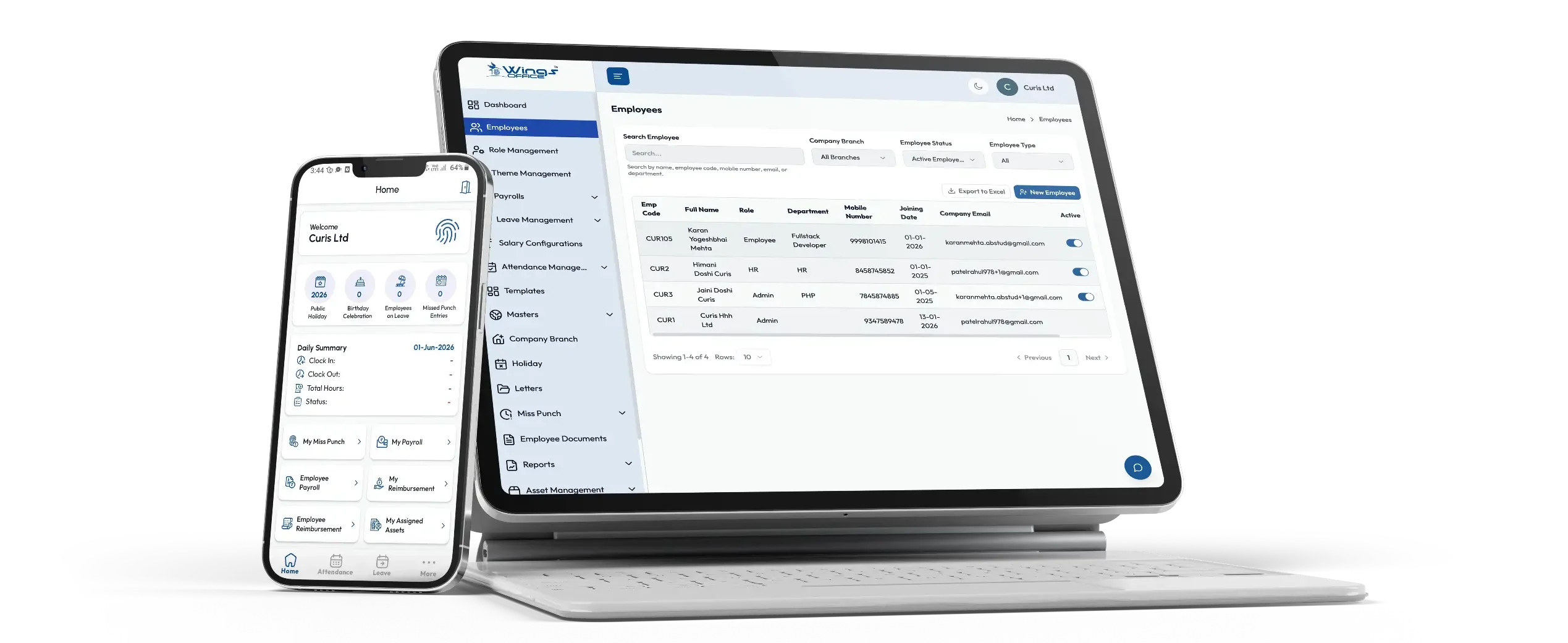
- Automated statutory compliance
Calculates PF, ESI, professional tax, and TDS automatically and adjusts when regulations change, reducing the risk of manual filing errors. - Attendance-linked salary processing
Pulls attendance and leave data directly into payroll runs, so salaries reflect actual hours without manual reconciliation. - Payslip and report generation
Produces payslips, Form 16, and payroll reports automatically instead of requiring someone to build them from scratch each cycle. - Employee self-service portals
Lets employees check payslips, apply for leave, and update details themselves, cutting down on repetitive HR requests. - Reimbursement and expense tracking
Captures reimbursements and advances and reflects them accurately in the next payroll cycle. - Multi-location and multi-entity support
Handles businesses operating across states with different compliance requirements from a single dashboard.
Each of these solves a specific, recurring pain point, not a hypothetical one. Businesses that adopt payroll software commonly report considerable reductions in processing time and calculation errors compared to manual methods, largely because the software removes the repetitive manual steps where mistakes creep in.
Top Features Loved by Business Owners
Talk to enough small business owners who’ve made the switch, and the same features come up repeatedly as the ones that actually change day-to-day operations:
Feature | Why Owners Value It |
Mobile app access | Runs payroll and approves leave from anywhere, not tied to a desktop |
Biometric or app-based attendance | Removes disputes over hours worked and reduces manual entry |
Compliance auto-updates | Keeps statutory calculations current without tracking law changes manually |
Single dashboard visibility | Gives owners a clear view of payroll status without chasing spreadsheets |
Fast onboarding | Gets new hires into the payroll system without duplicate data entry |
The common thread across all of these is time saved on administrative work that doesn’t move the business forward. Owners consistently mention that the value isn’t just accuracy — it’s getting hours back in a week that used to disappear into manual reconciliation.
A Representative Case: Retail Business, 40 Employees
To make this concrete, consider a common scenario among small retail businesses in India. A 40-employee retail chain with three store locations was running payroll manually through spreadsheets, with one staff member spending roughly three full days each month on attendance management, calculating deductions, and generating payslips.
Errors were frequent enough that employees regularly raised salary discrepancies, and the business had received a compliance notice after a delayed PF filing.
After switching to a cloud-based payroll platform with attendance integration, the business connected biometric attendance data directly to payroll processing across all three locations. Monthly processing time dropped from three days to under a single day. Salary discrepancy complaints from employees fell sharply, and statutory filings shifted from a manual, deadline-driven scramble to an automated, scheduled process.
This pattern of reduced processing time, fewer errors, and compliance handled proactively rather than reactively is consistent with what payroll software vendors and independent reviews report across small businesses adopting these platforms, particularly once attendance tracking and payroll calculation are connected rather than managed separately.
Conclusion: Choosing Payroll software for SMEs
Payroll software for small businesses isn’t a luxury reserved for companies with dedicated HR departments; it’s infrastructure that protects you from compliance risk while giving back hours you’re currently spending on manual reconciliation. The specific platform matters less than making the switch before an avoidable error costs you more than the software would have.
If you’re still weighing whether payroll software for SMEs is worth the investment, start by counting the hours your team spends on manual payroll each month and multiply that by what a single compliance mistake could cost.
For most small businesses, that math settles the decision quickly, and if you’re exploring which platform fits your specific operations, it’s worth working through a proper evaluation rather than defaulting to whatever a competitor uses.
Frequently Asked Questions
There’s no universal answer. GreytHR, Zoho Payroll, Wings Office, and Keka are all strong options depending on your team size, budget, and whether you’re already using a related software ecosystem.
Pricing varies by vendor and employee count, with several platforms offering free tiers for very small teams (typically under 5–25 employees) and paid plans scaling from there based on features and headcount.
It becomes valuable once manual tracking starts causing errors or compliance risk, which often happens sooner than owners expect, particularly once statutory deductions like PF and ESI apply.
Yes, most established Indian payroll platforms are built specifically around Indian compliance requirements and update automatically when regulations change.
Payroll software focuses specifically on salary calculation, deductions, and compliance. An HRMS is broader, often including payroll alongside recruitment, performance management, and employee lifecycle tools.