
Did you know that small businesses lose an average of 14 hours per week managing payroll manually? That’s nearly two full working days gone, not on growing your business, but on spreadsheets, tax calculations, and compliance paperwork. If that sounds familiar, you’re not alone.
This guide breaks down everything you need to know about HR and payroll software, from what it actually does to how to pick the right one for your business. Whether you’re running a 10-person startup or scaling a mid-size company, the right tool can save you time, reduce costly errors, and keep you on the right side of compliance.
What Is HR and Payroll Software?
HR and payroll software is a digital platform that automates the two most administratively heavy functions in any business: managing your people and paying them correctly.
At its core, it handles salary processing, attendance tracking, leave management, tax deductions, and employee records, all in one place. Instead of juggling multiple tools or relying on manual data entry, you get a single system that connects HR workflows to payroll outputs automatically.
A good HR payroll application does more than just run salaries. It manages onboarding, tracks performance, handles compliance filings, and gives employees self-service access to their own payslips and leave balances. Think of it as your HR department’s operating system.
HR and Payroll Software India: The Market You’re Operating In
India’s HR tech market is growing fast. The payroll software segment alone is projected to reach $1.6 billion by 2028, driven by GST reforms, complex PF and ESI compliance requirements, and the rapid digitization of small and mid-size businesses.
For businesses operating in India, compliance isn’t optional. You’re dealing with TDS deductions, PF contributions, ESI filings, professional tax across different states, and Form 16 generation, all of which carry penalties if mishandled. Manual processing simply can’t keep up with this regulatory complexity.
HR and payroll software India solutions are built specifically for this compliance landscape. They come pre-configured with Indian tax slabs, state-wise professional tax rules, and statutory filing formats. That means your team isn’t manually updating formulas every time the Finance Ministry revises tax brackets.
Pro Tip: When evaluating any HR and payroll software India vendor, ask specifically whether their platform auto-updates for statutory changes like revised TDS slabs or new ESI contribution rates. If they say you need to update it manually, walk away.
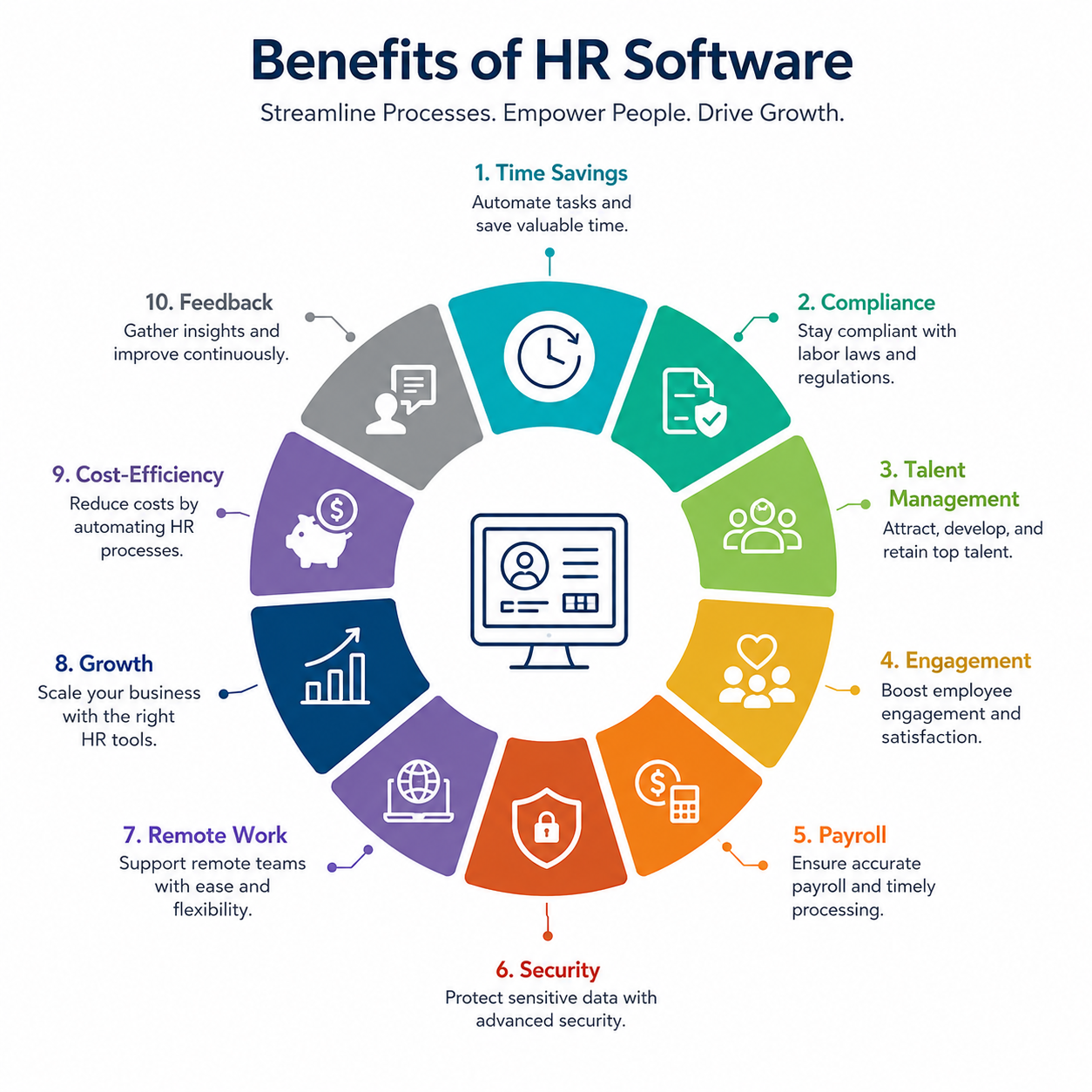
Key Benefits of Using HR Payroll Software for Your Business
Here’s where the real business case sits. The benefits aren’t just operational, they’re financial and strategic.
| Benefit | Business Impact |
|---|---|
| Automated salary processing | Eliminates manual errors, saves 10-15 hours/month |
| Tax compliance automation | Reduces penalty risk and CA dependency |
| Employee self-service portal | Cuts HR query volume by up to 40% |
| Integrated attendance and leave | Accurate payroll tied to real-time data |
| Audit-ready reports | Faster audits, cleaner books |
| Scalable as you grow | No need to switch systems at 50 or 200 employees |
For HR and payroll software for small business users specifically, the biggest win is usually time. Small business owners often wear multiple hats. Automating payroll gives those hours back to revenue-generating work.
Real-World Example: A 35-person logistics company in Pune switched from manual Excel payroll to a cloud-based HR payroll application. Within three months, they cut payroll processing time from two days to four hours, eliminated three recurring compliance errors, and gave employees 24/7 access to their payslips without a single HR ticket.
Does Payroll Software Handle Tax Compliance?
Yes, and this is one of the strongest reasons to adopt it. A well-built HR payroll application will handle:
- TDS calculation and deduction based on employee declarations
- PF and ESI contributions with automatic employer-employee split
- Professional tax is configured by state
- Form 16 and Form 24Q generation for annual filings
- Challans and returns for statutory deposits
The key word is “well-built.” Not every platform handles all of these out of the box. Some require expensive add-ons or third-party integrations for statutory filings. Always verify the compliance coverage before committing to a vendor.
Payroll Software for Industries: One Size Does Not Fit All
This is where most buying guides get lazy. They treat payroll software as a generic category. It isn’t.
Payroll software for industries varies significantly based on workforce structure, shift patterns, and compliance requirements.
| Industry | Specific Payroll Needs |
|---|---|
| Manufacturing | Shift-based wages, overtime calculation, contract labor compliance |
| IT and SaaS | Variable pay, ESOP management, remote workforce payroll |
| Retail and FMCG | High employee turnover, attendance-linked pay, multi-location payroll |
| Healthcare | Duty roster integration, allowance structures, statutory compliance |
| Construction | Daily wage workers, site-wise payroll, labor law compliance |
| Hospitality | Tip management, seasonal staff, multi-property payroll |
When evaluating payroll software for industries, ask vendors for client references in your specific sector. A platform built primarily for IT companies will struggle with the complexity of manufacturing shift wages or construction site labor compliance.
Pro Tip: If you’re in manufacturing or construction, prioritize platforms with built-in contract labor management. This is a common compliance gap that creates serious legal exposure.
How to Choose Payroll Software
Don’t buy on features alone. Evaluate vendors on these six criteria:
- Compliance coverage: Does it auto-update for Indian statutory changes without manual intervention?
- Integration capability: Does it connect with your existing accounting software, ERP, or attendance system?
- Scalability: Can it handle your headcount two or three years from now without a platform switch?
- Implementation support: Is there a dedicated onboarding team, or are you left with a help doc?
- Data security: Is employee data encrypted, role-based access controlled, and GDPR/IT Act compliant?
- Industry fit: Does the vendor have proven deployments in your specific sector?
FAQ
What is HR and payroll software, and do small businesses really need it?
HR and payroll software automates salary processing, tax deductions, attendance, and compliance filings. Small businesses benefit significantly because manual payroll is time-intensive and error-prone. Even a 10-person team can face compliance penalties from miscalculated TDS or missed PF filings. The cost of software is almost always lower than the cost of a single compliance error or the hours spent on manual processing each month.How does payroll software handle tax compliance in India?
Most Indian payroll platforms auto-calculate TDS based on employee investment declarations, compute PF and ESI contributions, apply state-wise professional tax, and generate Form 16 and Form 24Q. The best platforms also auto-update when tax slabs or statutory rates change, so your calculations stay accurate without manual intervention from your finance team.Can HR payroll software work for different industries?
Yes, but the configuration varies. Manufacturing needs shift-based wage calculations. Retail needs attendance-linked variable pay. IT companies need ESOP and variable component management. Always choose a platform that has proven deployments in your industry and can handle your specific workforce structure, not just a generic payroll engine.What should I look for when choosing payroll software for a small business?
Focus on ease of use, compliance automation, integration with your existing tools, and responsive support. For HR and payroll software for small business users, cloud-based platforms with employee self-service portals tend to deliver the fastest ROI. Avoid platforms that require heavy IT involvement to set up or maintain.How long does it take to implement HR and payroll software?
Implementation timelines vary by company size and complexity. A small business with under 50 employees can typically go live within two to four weeks. Larger organizations with complex payroll structures, multiple locations, or legacy system integrations may need eight to twelve weeks. Always ask vendors for a detailed implementation plan before signing.Final Thoughts
Payroll Isn’t Just A Back-Office Function. It’s A Direct Reflection Of How Much You Respect Your Employees’ Time And Trust. Getting It Wrong, Even Once, Damages Morale And Creates Legal Exposure. Getting It Right, Consistently And Automatically, Frees Your Team To Focus On What Actually Grows The Business.
The right HR and payroll software won’t just process salaries. It will reduce compliance risk, give your employees a better experience, and hand your HR team back hours they’re currently losing to manual work. If you’re ready to stop managing payroll the hard way, let’s talk. Book a free consultation with our team and we’ll help you find the right solution for your business size, industry, and compliance requirements.
Office Address:
TITANIUM SQUARE, A 204, Thaltej Rd, Patel Society, Jai Ambe Nagar, Thaltej, Ahmedabad, Gujarat 380054
Call us to book a free demo now:
+91 8200590214
Visit our website to get the latest updates
https://wingsoffice.in/



This article clearly explains why small businesses benefit from adopting integrated HR and payroll software instead of relying on manual processes. Automating payroll, attendance, and employee records helps reduce errors while saving valuable time. Solutions like HRM Thread show how businesses can manage these functions efficiently through a centralized platform. A useful resource for growing organizations.
Thanks for sharing your suggestion. Share with your friends and family who are looking for a trustworthy HRMS solution.