Running payroll in India is not simple. You have PF, ESI, TDS, professional tax, labour welfare fund, and now the four new labor codes active since November 2025, plus the new income tax act effective April 1, 2026, that mandates basic pay be at least 50% of total CTC. Miss any of these, and you are looking at penalties, audit exposure, and unhappy employees.
The right HRMS and payroll software handles all of it automatically. This guide covers what payroll software actually does, how to use it, which platforms lead the market in India, and what to pick if Keka is too heavy for your team size.
What Is Payroll Software?
Payroll software automates the process of calculating employee salaries, deducting statutory contributions, generating payslips, and disbursing payments on time, every month, without manual spreadsheet gymnastics.
In India, that means the software must handle:
- Gross-to-net salary calculation: basic pay, HRA, special allowances, and variable components
- Statutory deductions: PF (Provident Fund), ESI (Employee State Insurance), TDS (Tax Deducted at Source), and Professional Tax, which varies state by state
- Labour welfare fund contributions, which differ across states and are often overlooked
- Form 16 generation at year-end for employees
- Full & Final settlements under the 2026 Labour Code, these must now be processed within two working days of an employee’s exit
Standalone payroll tools focus purely on salary processing. HRMS (Human Resource Management System) platforms bundle payroll with attendance, leave, performance management, recruitment, and employee self-service into one unified system. For most Indian businesses beyond 20–30 employees, an HRMS approach eliminates the data reconciliation nightmare that comes from running separate systems.
How Payroll Software Works
The monthly payroll cycle in modern software follows a consistent flow:
- Data ingestion.
The system pulls attendance and leave data from integrated biometric devices, mobile punch-ins, or geo-tagged check-ins. Any leave-without-pay days, late arrivals flagged under the policy, or overtime hours are automatically factored in.
- Salary computation.
The engine applies each employee’s CTC structure, splitting basic, HRA, special allowance, and statutory components. Variable pay, incentives, and reimbursements are added. Deductions like loan EMIs, advance recoveries, and voluntary PF contributions are subtracted.
- Statutory compliance.
PF, ESI, TDS, Professional Tax (computed per the applicable state slab), and LWF are calculated automatically. Good software flags anomalies, for example, if a salary revision pushes an employee outside the ESI eligibility ceiling.
- Payroll review and approval.
HR or the finance team reviews a pre-disbursement summary. Any corrections, a missed reimbursement, or an incorrect CTC are made before the run is confirmed.
- Salary disbursement.
The software generates a bank file (typically NEFT/RTGS format or a direct integration with the company’s bank), and payslips are pushed to the employee self-service portal or via email or WhatsApp.
- Compliance filings.
Monthly ECR (Electronic Challan cum Return) for PF and ESI challan generation happens automatically. Quarterly TDS returns (Form 24Q) and year-end Form 16 issuance are built into the calendar.
The entire cycle that once took an HR team three to four days can run in under a few hours or, with some platforms, closer to a few minutes for small teams.
How to Use Payroll Software
If you are implementing payroll software for the first time, here is what the setup and monthly usage typically look like:
Setup phase (one-time)
- Configure your company’s salary structure, define pay components, allowances, and reimbursement categories
- Import employee master data names, PAN, Aadhaar, bank account details, PF/ESI UAN numbers, and CTC details.
- Set up statutory configurations, PF applicable or not per employee, professional tax state, ESI eligibility, and TDS regime (old or new).
- Integrate attendance, connect biometric devices, configure mobile app punch-in rules, or import attendance data from your existing system.
- Define leave policies, earned leave, sick leave, casual leave, and carry-forward rules.
Monthly usage
- Freeze attendance for the payroll period.
- Add variable inputs: performance bonuses, arrears, reimbursement claims, and loan EMIs.
- Run a payroll preview and check the variance report (flags employees whose net pay changed by more than a defined threshold).
- Approve and process.
- Download the bank transfer file, generate payslips, and file statutory challans.
Most modern platforms make steps 3–5 take under 30 minutes once your data is clean.
HRMS and Payroll Software in India
The right tool depends on your company size, payroll complexity, and whether you need full HRMS functionality or a payroll-first approach.
1. Keka HR Best for Mid-Market Companies
Keka is one of the most widely adopted HR and payroll platforms for mid-sized Indian businesses. It covers the full employee lifecycle: payroll, attendance (including geo-fencing, selfie punch-in, and biometric integration), leave management, performance management, and an applicant tracking system.
The payroll engine handles complex salary structures and statutory compliance well. The employee self-service portal is clean, and the mobile app is genuinely usable. Teams of 100–1,000 employees generally find Keka hits the right balance of depth and usability.
Where it can feel heavy: smaller businesses sometimes find the configuration overhead and pricing structure better suited to companies that need all of its modules.
2. greytHR Best for Payroll-First SMBs
greytHR is trusted by over 25,000 Indian SMEs and has built its reputation on payroll accuracy and statutory compliance depth. The platform covers all India-specific compliance requirements: PF, ESI, TDS, Form 16, and multi-state professional tax and offers 150+ pre-built payroll, attendance, and leave reports.
It is not the most visually modern platform, but it is reliable and deeply understood by Indian payroll teams. For a business where payroll compliance is the primary concern and design aesthetics are secondary, greytHR is a solid choice.
Starting pricing is accessible for small teams, which makes it a frequent first payroll tool for companies moving off spreadsheets.
3. Darwinbox Best for Enterprise
Darwinbox is the go-to HRMS for large Indian enterprises. It was recognised as a Challenger in Gartner’s Magic Quadrant for Cloud HCM Suites in both 2024 and 2025, and Forrester named it a Strong Performer in its Q4 2025 Human Capital Management Wave.
The platform handles payroll, attendance, core HR, recruitment, and workforce analytics in one unified system with a mobile-first experience suited for distributed, multi-location organisations. For enterprises with 1,000+ employees managing HR across multiple states and geographies, Darwinbox is the India-native choice.
4. Zoho Payroll / Zoho People Best for Small Businesses Already on Zoho
Zoho Payroll handles India-specific compliance, including PF, ESI, PT, and TDS, and integrates natively with Zoho Books for accounting. For small businesses already using Zoho’s CRM, Books, or other products, the payroll and HRMS modules add significant value without introducing another vendor relationship.
Starting at ₹48 per employee per month, it is one of the more affordable options with a genuine feature set. The product has continued maturing, though it is best suited for companies under ~200 employees.
5. RazorpayX Payroll Best for Startups Wanting Fast Setup
RazorpayX Payroll is built for speed. It is designed for companies that want to go from zero to running payroll quickly, with a clean interface and bank-grade salary payment infrastructure built on Razorpay’s banking stack. Compliance coverage for PF, ESI, and TDS is included.
It works best for tech startups and companies with a relatively straightforward payroll structure. Multi-state complexity and deep HRMS needs are better served elsewhere.
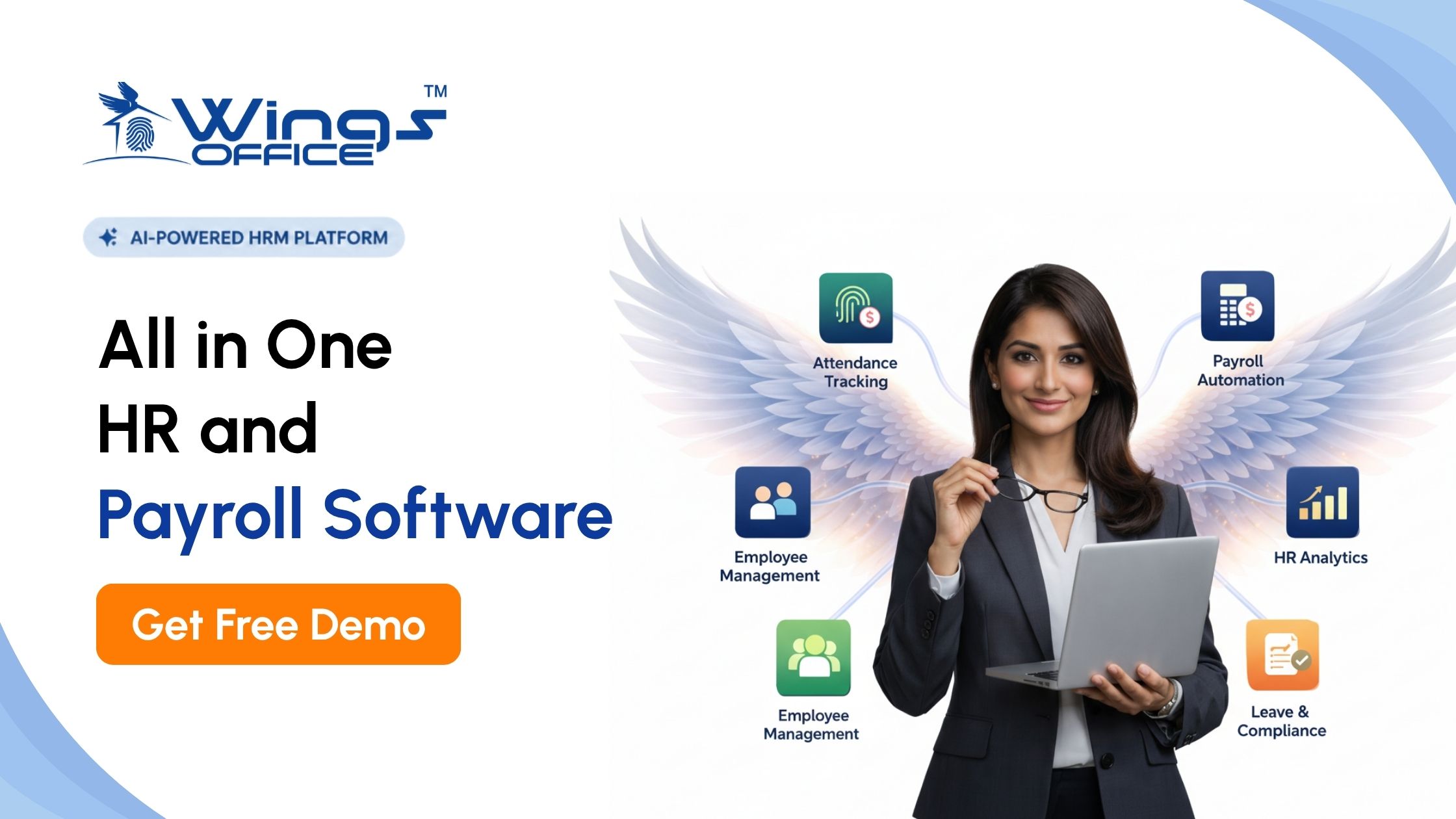
6. Wings Office Best Mid-Market HRMS with AI Chatbot
Wings office has built significant momentum in mid-market India, with over 500 small businesses and SMEs registered on this platform. A standout feature is its AI chatbot-managed queries, a centralized section that consolidates pending approvals and employee requests across payroll, leave, expense, and recruitment, designed to reduce tab-switching and close routine tasks faster. This reduces HR ticket volume for common queries.
Its AI Suite, launched in India and offering a free trial to all over the business industry, has started using it, the best fit for companies in the 50–500 employee range.
7. Pocket HRMS Best AI-Assisted Option at SMB Price
Pocket HRMS sits in a useful category: AI-assisted HRMS at prices accessible to smaller and growing mid-market businesses. Its smHRty chatbot handles employee queries on payslips, leave balances, and tax declarations without HR needing to intervene, which is useful for companies where HR is a team of one or two people managing hundreds of employees.
Full statutory coverage, multi-state PT, and Form 16 generation are included.
Alternatives to Keka for Small Businesses
Keka is well-built, but its pricing and feature density make it more suited to teams with dedicated HR functions. If you are a startup or SME with under 100 employees, here are the alternatives worth evaluating:
Wings Office is another strong alternative for SMEs with field or factory workers. Its attendance-to-payroll integration is tight, and it handles shift-based payroll well, something simpler platforms can struggle with.
GreytHR remains the most proven payroll-first option for Indian SMEs. Its compliance depth is hard to beat at its price point, and it requires minimal HR expertise to operate once configured.
Zoho Payroll makes sense if your business already lives in the Zoho ecosystem. The integration with Zoho Books alone saves significant reconciliation time.
Zimyo has built a clean, India-first compliance engine with a modern interface and fast onboarding. For HR leaders who found Keka’s implementation timeline frustrating, Zimyo offers a simpler path to go live. The platform covers the entire employee lifecycle and is designed for organisations wanting automation without complexity.
Craze is worth considering for startups that want payroll automation, leave and attendance management, performance management, and Indian labor law compliance without a heavy price tag. Its user experience and customer support are consistently rated highly in the sub-200-employee segment.
The quick decision filter for small businesses: if your primary pain is payroll compliance accuracy, go greytHR. If you want an all-in-one system that can grow with you without re-implementing, Zimyo or Craze islabour worth a demo.
AI-Powered HR and Payroll Software Features
AI has moved from a marketing word on HRMS product pages to genuinely useful features in the leading platforms. Here is what actually matters:
Predictive attrition analytics.
Platforms like Darwinbox and PeopleStrong now surface risk signals before an employee resigns based on engagement scores, leave patterns, peer feedback, and compensation benchmarks. HR teams with this data can have retention conversations before they lose someone.
AI-assisted recruitment.
Automated job description generation, resume screening, and candidate ranking based on role fit reduce time-to-hire and recruiter workload. HROne, Darwinbox, and Zimyo have all shipped meaningful versions of this.
Conversational employee self-service.
Chatbots like Pocket HRMS’s smHRty handle the routine questions “What’s my leave balance?”, “Where’s my payslip?” “How much TDS has been deducted?” This otherwise creates low-priority tickets for HR teams. At scale, this meaningfully reduces HR admin load.
Compliance auto-alerts.
AI systems now monitor salary data and flag potential violations of an employee’s CTC structure that violate the new 50% basic pay rule, an ESI eligibility threshold crossed after a salary revision, or a PT slab change in a state where the business recently added headcount. These alerts catch errors before they become filings.
Intelligent payroll anomaly detection.
Before payroll is processed, AI flags unusual variances, a net pay that dropped by more than 20% from last month, an employee with no attendance data, and a new joiner whose tax has not been configured. This step alone reduces the back-and-forth in payroll review cycles.
AI-powered attendance.
Face-recognition attendance has moved from enterprise-only to available at SMB price points. Platforms like SalaryBox and Zimyo offer hardware-free, software-based face recognition via mobile for teams that do not want to invest in biometric hardware at every location.
Workforce analytics and dashboards.
The better platforms now give HR leadership real-time dashboards on headcount, attrition, leave utilization, payroll cost as a percentage of revenue, and overtime trends—data that used to require custom reports and significant manual work.
How to Choose: A Quick Framework
Before picking a platform, answer four questions:
- How many employees do you have, and how fast are you growing?
Tools like Craze and Zoho Payroll are ideal for under 200 employees. Keka and HROne suit 100–1,000. Darwinbox and PeopleStrong are built for 1,000+.
utilisation - How complex is your payroll?
If you have multi-state operations, factory workers on shift schedules, and multiple salary structures, you need a platform with a deep statutory engine: greytHR, Keka, or HROne. If payroll is straightforward, almost any platform handles it. - Do you need full HRMS or payroll-only?
If you already have a performance management tool and an ATS you are happy with, a payroll specialist like GreytHR or RazorpayX Payroll is cleaner than buying a full HRMS and ignoring half its modules. - What does implementation look like?
Darwinbox and enterprise HRMS implementations take months. RazorpayX Payroll and Zoho Payroll are weeks ahead. If you need to be live in 30 days, filter your list accordingly.
The payroll software market in India is competitive, well-developed, and increasingly AI-native. Whether you are a 20-person startup running payroll for the first time or a 5,000-person enterprise dealing with multi-state complexity, there is a purpose-built option. The key is matching the tool to your current size, compliance burden, and how much HR automation you actually want, not just buying the one with the most features.
Office Address:
TITANIUM SQUARE, A 204, Thaltej Rd, Patel Society, Jai Ambe Nagar, Thaltej, Ahmedabad, Gujarat 380054
Call us to book a free demo now:
+91 8200590214
Visit our website to get the latest updates