
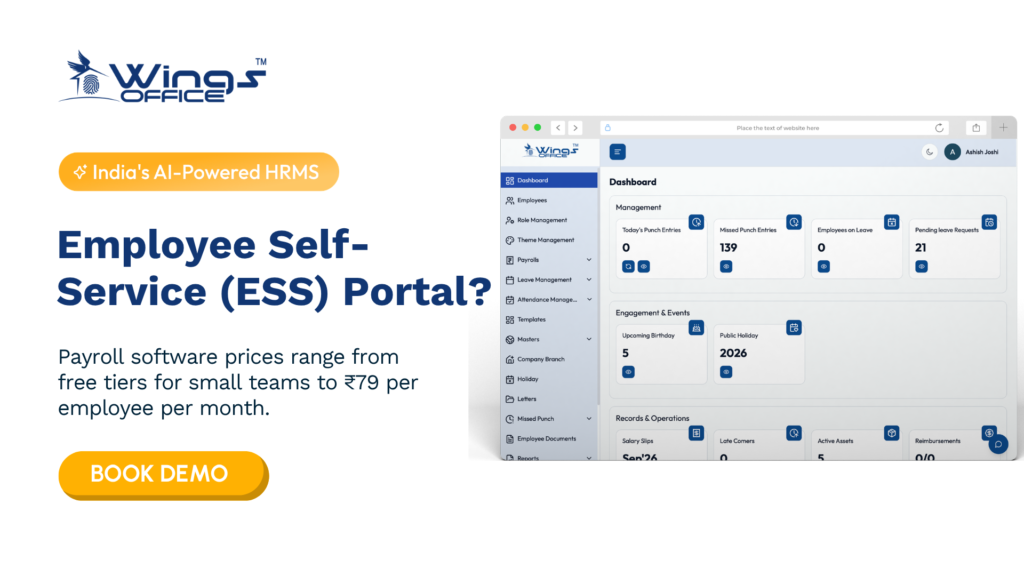
What Is an Employee Self-Service (ESS) Portal? 2026 Guide for Indian Businesses
Key Takeaways An Employee Self-Service (ESS) Portal lets staff handle routine HR tasks like leave requests, payslip access, and profile updates themselves, cutting the admin load on HR teams. For Indian businesses, the right portal must handle statutory realities like PF, ESI, TDS, Form 16, and multi-state compliance, not just generic HR workflows. The real return on an ESS portal comes from reclaimed HR hours, fewer payroll errors, and faster query resolution, which you can estimate with a simple ROI model. Choosing an ESS solution for India means prioritising compliance depth, mobile access, and local payroll logic over feature count. Every month, HR teams across India spend hours answering the same questions. “What’s my leave balance?” “Can you resend my payslip?” “How do I update my bank details?” None of these need a human to answer. An Employee Self-Service (ESS) Portal exists precisely to stop that drain, handing routine tasks back to employees and freeing HR to do work that actually needs judgment. This guide walks through what an ESS portal is, how it works, the features that matter, and what Indian businesses specifically need to watch for in 2026 when compliance and payroll rules rarely behave like the textbook. What an Employee Self-Service (ESS) Portal Actually Is An Employee Self-Service (ESS) Portal is a secure online system where employees manage their own HR-related information and requests without routing everything through the HR department. Think of it as the self-checkout counter of HR: the employee does the work that only they can verify, like confirming a leave date or checking a payslip, while the system handles the record-keeping in the background. At its core, an employee self-service portal replaces email threads, paper forms, and spreadsheet trackers with a single interface. An employee logs in to apply for leave, view salary breakups, download tax documents, update personal details, or submit reimbursement claims. Managers use the same system to approve requests and view team data. HR sets the rules once, and the portal enforces them consistently. The shift is less about technology and more about ownership. In a traditional setup, HR is the bottleneck for every small action. With ESS, employees own their data and routine transactions, and HR steps in only for exceptions, policy decisions, and the work that genuinely requires a person. How an ESS Portal Actually Works Behind the clean login screen, an ESS portal connects to your core HR and payroll database. When an employee submits a request, the system doesn’t just store it. It triggers a workflow. Say an employee applies for three days of leave. The portal checks the available balance against company policy, routes the request to the right manager, and sends a notification. Once approved, it updates the leave ledger, adjusts the attendance record, and feeds that information into payroll so the salary calculation reflects it. No one re-enters anything by hand. This is where the real value sits: integration. A portal that only collects requests but still needs HR to manually update the master records solves very little. The useful ones connect leave, attendance, payroll, and employee records so a single action updates every downstream system at once. Access is controlled by role. Employees see their own information. Managers see their team. HR and admin see the full picture with permission to edit policies and override exceptions. Modern portals also run on mobile, which matters for field staff, factory workers, and anyone who doesn’t sit at a desk all day. Key Features and Functionalities of an ESS Portal Not every ESS portal has features of the same depth, and the feature list is where buying decisions usually go wrong. People get impressed by the longest list rather than the features their workforce will actually use. Here are the functions that carry real weight. Leave and attendance management is the most-used feature by a wide margin. Employees apply for leave, check balances, and view attendance records. Managers approve on the spot. The system enforces leave policies automatically, including carry-forward rules and different quotas for different grades. Payslip and salary access lets employees view and download payslips without raising a ticket. A good portal shows the full breakdown: basic, allowances, deductions, and net pay, so employees understand what they’re paid and why. Tax and compliance documents matter enormously in India. Employees should be able to submit investment declarations, download Form 16, and view TDS details directly. This single feature removes one of the heaviest seasonal loads from HR around tax time. Personal information updates let employees correct their address, phone number, bank account, or emergency contact, usually with an approval step so changes to sensitive fields like bank details get verified before they hit payroll. Reimbursement and expense claims allow staff to upload bills, submit claims, and track approval status instead of chasing finance over email. Document center stores offer letters, appraisal records, company policies, and certificates in one place employees can access anytime. Pro Tip: Before comparing feature lists, pull a month of HR query tickets and sort them by type. The three most frequent query categories should map directly to the first three features you prioritise. Everything else is secondary. Benefits of ESS Portals for Businesses and Employees The case for ESS splits cleanly into two audiences, and both need to feel the gain for adoption to stick. For the business, the biggest win is time. HR teams stop acting as a help desk for routine queries and reclaim hours for hiring, retention, and strategy. Data accuracy improves because employees enter and verify their own details rather than HR transcribing them from forms. Compliance gets tighter because documents, declarations, and approvals leave a clear audit trail. And payroll errors drop, since the information flowing into salary calculation is confirmed at the source. Benefits for Employees Employees gain control and speed. No more waiting two days for someone to confirm a leave balance or resend a payslip. They can check information at midnight if they want, from their phone, without feeling like