
Quick summary: Running payroll by hand still costs Indian businesses time, money, and sleep one missed PF deadline or one wrong TDS calculation can turn a routine month-end into a compliance headache. The best payroll software in India fixes this by automating salary runs, statutory deductions, and reporting, so business owners and HR teams stop firefighting and start planning.
I’ve sat across the table from enough founders and HR heads to know the pattern by heck: payroll starts on a spreadsheet, works fine for a dozen employees, and then quietly becomes the most stressful task on someone’s calendar. Nobody plans for payroll to become a crisis. It just does, usually right around the time a company crosses 30-40 employees, adds a second state of operation, or hires its first remote team member.
That’s really what this piece is about not software features in the abstract, but the specific, recurring pain points that push business owners, IT managers, and finance leads toward payroll software for businesses in the first place. If you’re a decision-maker weighing whether it’s finally time to move off Excel or you’ve already decided and you’re trying to figure out which platform actually deserves your budget, this is written for you.
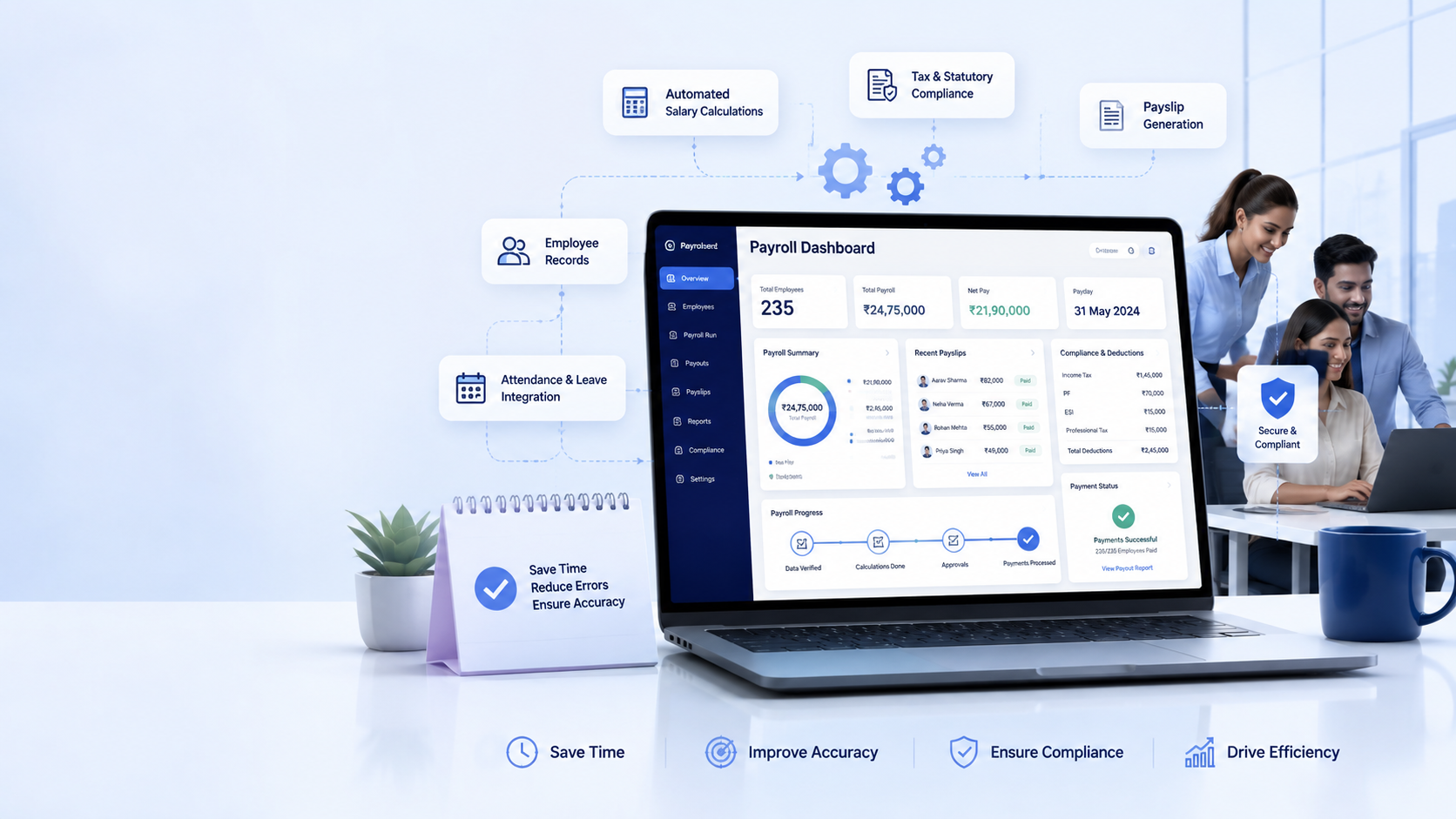
Why Businesses and Industries Need Payroll Software Today
Payroll in India isn’t just “pay the salary and move on.” It touches the provident fund, employee state insurance, professional tax, TDS, and increasingly, state-specific labor codes that don’t always align neatly with each other. A manufacturing unit in Maharashtra and a software firm in Karnataka can have genuinely different compliance obligations, even for employees at the same pay band.
Add to that the operational reality: attendance data living in one tool, leave requests in another, and salary structures sitting in someone’s personal laptop. Every month, someone has to stitch all of this together under a deadline. That’s not a workflow — it’s a liability waiting to happen, especially as headcount grows and the margin for manual error shrinks.
Manual Payroll Challenges Businesses Face
Ask any HR manager who’s run payroll manually for more than a year, and they’ll tell you the same thing: it’s not one big problem; it’s a dozen small ones that pile up.
- Calculation errors in overtime, bonuses, or pro-rated salaries that go unnoticed until an employee flags a shortfall
- Missed statutory deadlines for PF or ESI remittance, which can trigger penalties that nobody budgeted for
- Single points of failure — payroll knowledge locked in one person’s head, with no backup if they’re on leave
- Version chaos across spreadsheets, where the “final” file isn’t actually final
- No audit trail, making it hard to explain a discrepancy when an employee or auditor asks a pointed question
None of this is a knock on the people doing the work. Manual payroll asks humans to behave like machines, month after month, without the safety net machines are built for.
How Payroll Automation Improves Accuracy and Compliance
This is where automation earns its keep, not by being flashy, but by being boring in the best way. A payroll system pulls attendance, leave, and salary structure into one place, applies the correct statutory rules automatically, and produces payslips and compliance filings without someone re-typing numbers at 11 PM.
The accuracy gain is obvious. The compliance gain is subtler but arguably more valuable most platforms update their statutory rule engines when PF, ESI, or TDS regulations change, so businesses aren’t relying on a finance team member to have read the latest circular. For a CFO or business owner, that’s the difference between compliance being a monthly scramble and compliance being something the system quietly handles in the background.
Useful Features to Look for in the Best Payroll Software in India
Not every payroll tool is built the same, and feature lists can blur together after a while. Here’s what actually matters when you’re comparing options:
Feature | Why It Matters |
Automated salary & payslip generation | Cuts processing time from days to hours |
PF, ESI, TDS, and professional tax handling | Keeps statutory filings accurate and on time |
Attendance and leave integration | Removes manual data transfer errors |
Employee self-service portal | Reduces HR’s inbox load significantly |
Multi-location / multi-state support | Handles varying state labor laws correctly |
Reporting and payroll analytics | Gives leadership visibility into cost trends |
Role-based access and audit logs | Protects sensitive salary data |
API or accounting software integration | Avoids duplicate data entry across systems |
If a platform is missing more than one or two of these, it’s worth asking why before you sign a contract.
Top Payroll Software Options Available in India
India’s payroll software market is fairly mature now, and the “best” option genuinely depends on your size and complexity, not a single universal winner.
- For small businesses (under 50 employees):
lightweight tools that focus on core payroll processing, payslips, and basic compliance — easy to set up without a dedicated IT team - For mid-sized companies:
platforms with attendance integration, benefits administration, and multi-department reporting built in - For large enterprises and multi-state operations:
systems with deep compliance automation, HRMS integration, and dedicated support for complex org structures - For CA firms and consultants managing multiple clients:
tools built specifically for multi-entity payroll management from a single dashboard
Rather than chasing a “best overall” label, shortlist two or three options that fit your employee count and industry, then trial them against your actual payroll data before committing.
How Payroll Software Helps Industries Manage Payrolls
Different industries lean on payroll software differently, and it’s worth being honest about that instead of pretending one template fits everyone.
- Manufacturing and factories often need shift-based wage calculations, overtime rules, and statutory bonus tracking tied closely to attendance systems
- IT and services firms typically prioritize flexible salary structures, remote employee handling, and integration with HRMS platforms
- Retail and hospitality deal with high employee turnover and part-time staff, so fast onboarding and quick payslip generation matter more than deep customization
- Healthcare organizations need to manage complex shift patterns alongside strict compliance, given the sensitivity of staffing continuity
- CA and consulting firms need multi-client segregation, so one firm’s payroll data never mixes with another’s
The common thread across all of these: the software should adapt to how the industry actually operates, not force the business to adapt to the software.
Benefits of Using Payroll Software for Businesses
Strip away the marketing language, and the real benefits come down to a handful of things that matter to anyone running a business.
- Time back. Payroll runs that took three days can often be done in a few hours.
- Fewer errors. Automated calculations reduce the salary disputes that quietly erode employee trust.
- Compliance confidence. Statutory deductions and filings happen correctly, without someone cross-checking a government circular at the last minute.
- Better visibility. Leadership gets clean reports on payroll costs instead of static spreadsheets nobody trusts.
- Employee satisfaction. Self-service portals mean employees can check their own payslips and tax declarations without emailing HR every time.
None of these benefits show up instantly on day one. They show up in month three or four, once the system has replaced the habits that used to eat everyone’s time.
How to Choose the Best Payroll Software in India
This is usually where businesses get stuck, because every vendor’s website reads roughly the same. A few honest questions cut through that noise faster than any feature comparison:
- Does it handle your specific statutory obligations correctly
PF, ESI, TDS, and any state-specific labor codes relevant to where you operate? - Can it scale with you without forcing a painful migration in two years?
- Does it integrate with your existing accounting or HR systems, or will you end up entering data twice?
- Is the support responsive when something goes wrong during an actual payroll run, not just during the sales pitch?
- Can your team actually use it without a steep learning curve or constant IT intervention?
If a vendor can’t answer these clearly or dodges the compliance question specifically, treat that as a red flag rather than a technicality.
Conclusion
Payroll isn’t glamorous, and it never will be. But it’s one of the few business functions where a mistake is immediately visible to every single employee, every single month. Manual processes that worked at ten people start cracking at fifty, and the cost of that crack in errors, penalties, and eroded trust is almost always higher than the cost of fixing it early.
The best payroll software in India isn’t the one with the longest feature list. It’s the one that matches your industry’s actual working patterns, scales with your headcount, and takes statutory compliance off your plate without you having to double-check its work every month. Whether you’re a founder running your first payroll cycle or a CFO managing operations across states, the right payroll software for businesses turns a recurring source of stress into something you genuinely stop thinking about.
If you’re weighing your options and want a clearer, data-backed view of what fits your specific industry and workforce size, it’s worth exploring the data-oriented payroll and compliance services available on our site before making that call
Frequently Asked Questions
1. Which is the best payroll software in India for small businesses?
It depends on your employee count and compliance needs, but the strongest fit for small businesses is usually a platform that handles PF, ESI, and TDS automatically while keeping setup simple, without requiring a dedicated IT resource to run.
2. How much does payroll software cost in India?
Pricing typically scales with employee count and features, ranging from budget-friendly per-employee monthly plans for small teams to custom enterprise pricing for larger organizations with multi-state or multi-entity needs.
3. Is payroll software safe for storing employee salary data?
Reputable payroll platforms use encryption, role-based access controls, and audit logs to protect sensitive salary information, which is generally far more secure than spreadsheets stored on individual laptops.
4. Can payroll software handle PF, ESI, and TDS compliance automatically?
Yes, most established payroll software for businesses in India is built specifically to calculate and file these statutory deductions automatically, updating rules when government regulations change.
5. What is the difference between payroll software and HR software?
Payroll software focuses specifically on salary calculation, statutory compliance, and payslip generation, while HR software covers broader functions like recruitment, performance management, and employee engagement many platforms now combine both.