
Picture this: it’s 2 AM, three nurses just called in sick, and the charge nurse is scrambling through a paper roster trying to figure out who’s on call. This isn’t a rare emergency. It’s Tuesday night at hospitals across the country. A single scheduling gap in a critical care unit can cost a hospital thousands in emergency staffing fees and, worse, put patient safety at risk.
This is exactly why more hospital owners, clinic administrators, and physicians are turning to HRMS for hospitals to fix what paper trails and spreadsheets never could. A dedicated HRMS for hospitals doesn’t just automate payroll. It brings order to chaotic shift patterns, keeps compliance airtight, and gives clinical leaders their time back. In this post, we’ll break down why centralised HR systems have become non-negotiable for healthcare and how to calculate the real ROI before you invest a single rupee or dollar.
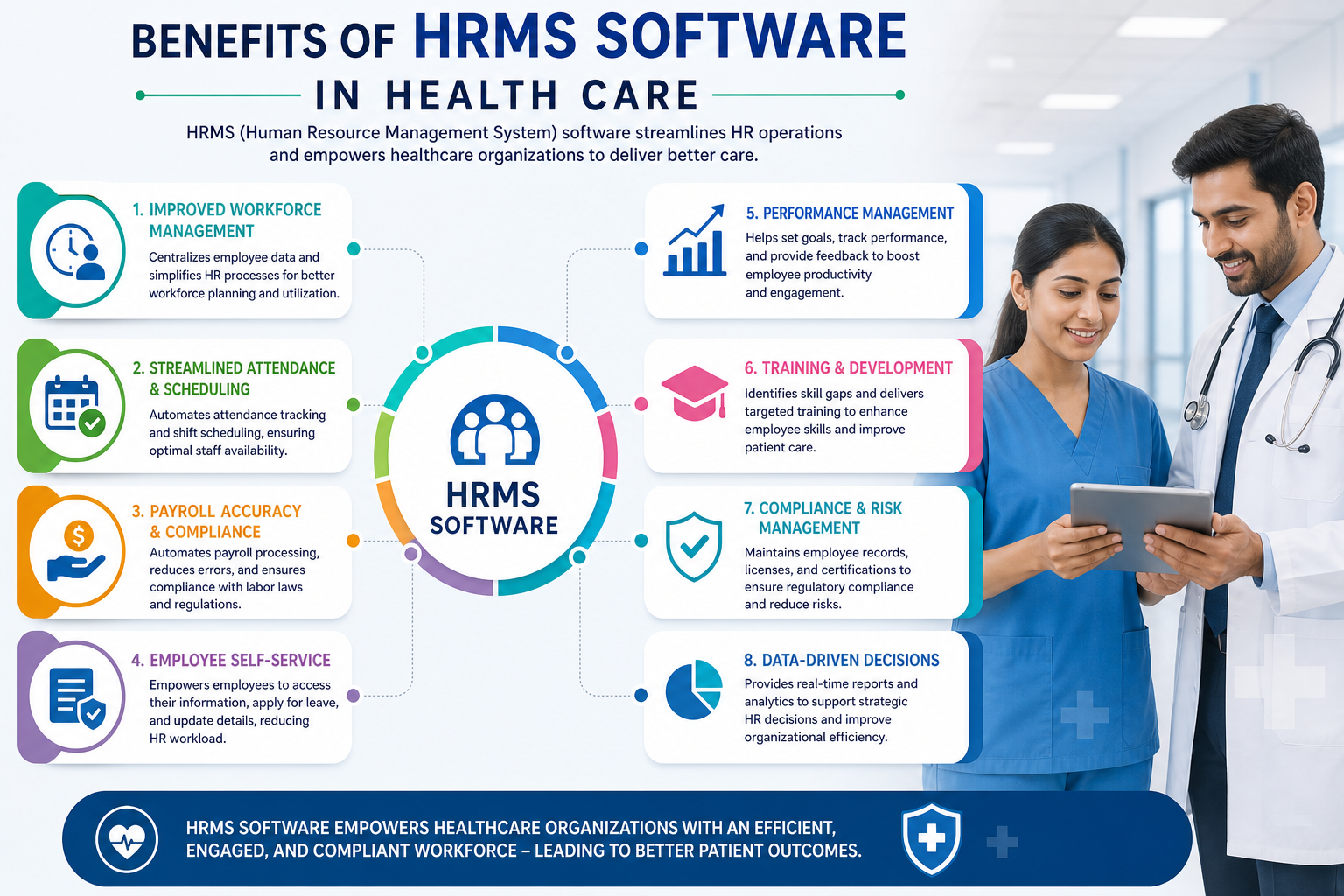
7 Reasons Why the Healthcare Sector Needs Centralized HRMS
Healthcare staffing isn’t like retail or manufacturing. You can’t just “figure it out later” when a shortage hits the ICU. Here’s why centralised HR systems have become a survival tool, not a luxury.
1. Shift chaos is a patient safety issue, not just an admin headache.
Symptom: Nurses working back-to-back doubles, understaffed night shifts, and last-minute scrambling.
Cause: Manual rosters built in Excel with no real-time visibility into fatigue, leave balances, or certifications.
Real cost: Studies from the American Nurses Association link fatigue directly to a rise in medication errors and adverse patient events.
Solution: A centralised HRMS automates shift allocation based on skill, availability, and legal rest periods, flagging conflicts before they become crises.
2. Compliance tracking eats up hours nobody has.
Hospitals juggle licensing renewals, background checks, and continuing education mandates for hundreds of staff. Miss one renewal deadline and you risk regulatory penalties or, worse, an unlicensed practitioner treating patients. Centralised HRMS platforms send automated renewal alerts months in advance.
3. Payroll errors erode staff trust fast.
Doctors and nurses working odd hours, on-call shifts, and overtime need accurate, transparent pay. Manual payroll calculations across multiple shift differentials are a recipe for disputes and turnover.
4. Credentialing gets lost in email threads.
Verifying a new hire’s licence, malpractice history, and board certifications shouldn’t take six weeks. Integrated HRMS platforms centralize document verification, cutting onboarding time significantly.
5. Multi-location hospital groups lack visibility.
If you run three clinics or a hospital chain, you need one dashboard, not five spreadsheets, to see staffing gaps across locations.
6. Burnout and attrition are financial disasters.
The average cost to replace a registered nurse ranges between $40,000 and $60,000, according to NSI Nursing Solutions. Poor scheduling is a top driver of resignations.
7. Data silos slow down leadership decisions.
Without centralised HR data, hospital administrators can’t answer basic questions like “which department has the highest overtime spend?” quickly.
Case in point: A mid-sized 200-bed hospital in Texas implemented a centralized HRMS in 2022 and reported a 30% drop in overtime costs within eight months, simply by automating shift matching and eliminating double-booking errors.
Pro Tip: Start your HRMS rollout with the nursing department first. It’s typically the largest staff pool and the one where scheduling chaos hits hardest, giving you the quickest visible win to justify wider adoption.
Calculating the ROI of Upgrading Your Healthcare HR Software
Hospital owners often hesitate on HR software upgrades because the upfront cost looks steep. But the math tells a different story once you factor in what manual processes are actually costing you.
The global healthcare HR software market was valued at roughly $2.4 billion in 2023 and is projected to grow past $5 billion by 2030, according to Grand View Research. That growth isn’t hype. It reflects a real shift as hospitals recognise that staffing software pays for itself.
Here’s a simple framework to calculate your own ROI:
| Cost Factor | Manual Process (Annual) | With HRMS (Annual) |
|---|---|---|
| Overtime due to scheduling errors | $150,000 | $95,000 |
| Agency staffing fill-ins | $80,000 | $40,000 |
| HR admin hours (payroll, compliance) | 2,000 hours | 600 hours |
| Turnover replacement costs | $200,000 | $130,000 |
| Compliance fines/risk exposure | Variable, high risk | Minimal |
Even a mid-sized hospital can see six-figure annual savings once overtime, agency staffing, and turnover costs are reduced through better scheduling and retention tools.
The full lifecycle typically includes the following:
- Needs assessment and current workflow audit
- Vendor selection and system configuration
- Data migration from legacy systems
- Staff training and phased rollout
- Ongoing support and quarterly performance reviews
Vendor Evaluation Checklist:
- Does it offer healthcare-specific compliance tracking (licences, certifications)?
- Can it handle complex shift patterns (rotating, on-call, split shifts)?
- Is there mobile access for staff to view schedules and swap shifts?
- Does it integrate with your existing payroll and EHR systems?
- What’s the average implementation timeline and support response time?
- Are pricing tiers transparent with no hidden per-user fees?
Pro Tip: Ask any vendor for a case study from a hospital of similar bed size and specialty mix. Generic testimonials rarely reflect the operational reality of your facility.
Frequently Asked Questions
What is HRMS for hospitals?
HRMS for hospitals is software that centralises staff scheduling, payroll, compliance tracking, and credentialing in one system. It replaces manual spreadsheets and paper rosters with automated tools built specifically for healthcare shift complexity, licensing requirements, and multi-department coordination.
How do I know if my hospital needs a centralised HRMS?
If you’re spending hours weekly fixing scheduling conflicts, chasing licence renewals, or dealing with payroll disputes, you need one. Any facility with over 50 staff across multiple shifts typically sees measurable ROI within the first year.
Why does staffing software reduce nurse turnover?
Fair, predictable scheduling reduces burnout, one of the top reasons nurses leave. HRMS platforms distribute shifts equitably and flag overwork risks before staff reach breaking point, improving retention and morale.
Can HRMS integrate with our existing EHR system?
Most modern healthcare HR platforms offer API integrations with common EHR systems. Always confirm compatibility during vendor evaluation since seamless data flow between HR and clinical systems saves significant administrative time.
Should I upgrade HR software if my hospital is small?
Yes. Smaller hospitals and clinics often feel scheduling chaos more acutely since there’s less staff to absorb gaps. Cloud-based HRMS options now offer scalable pricing suited to smaller facilities.
Final Thoughts
Staffing chaos isn’t a problem you can spreadsheet your way out of anymore. Between compliance risk, burnout, and rising agency costs, hospitals that stick with manual HR processes are quietly bleeding money and staff. A centralised HRMS for hospitals brings clarity to scheduling, protects your compliance standing, and gives your leadership team the data to make smarter decisions, not just faster ones.
If staffing gaps, overtime spikes, or compliance scrambles sound familiar, it’s time to see what a purpose-built HRMS can do for your facility. Book a consultation with our healthcare HR specialists today and get a tailored ROI estimate for your hospital.