
EMPLOYEE DOCUMENTS
Employee Document Management HRMS
PAN cards, Aadhaar, offer letters, payslips, and certificates are all stored securely in one place. Employees upload their own documents. HR verifies and approves. Expiry alerts ensure nothing slips through the cracks.
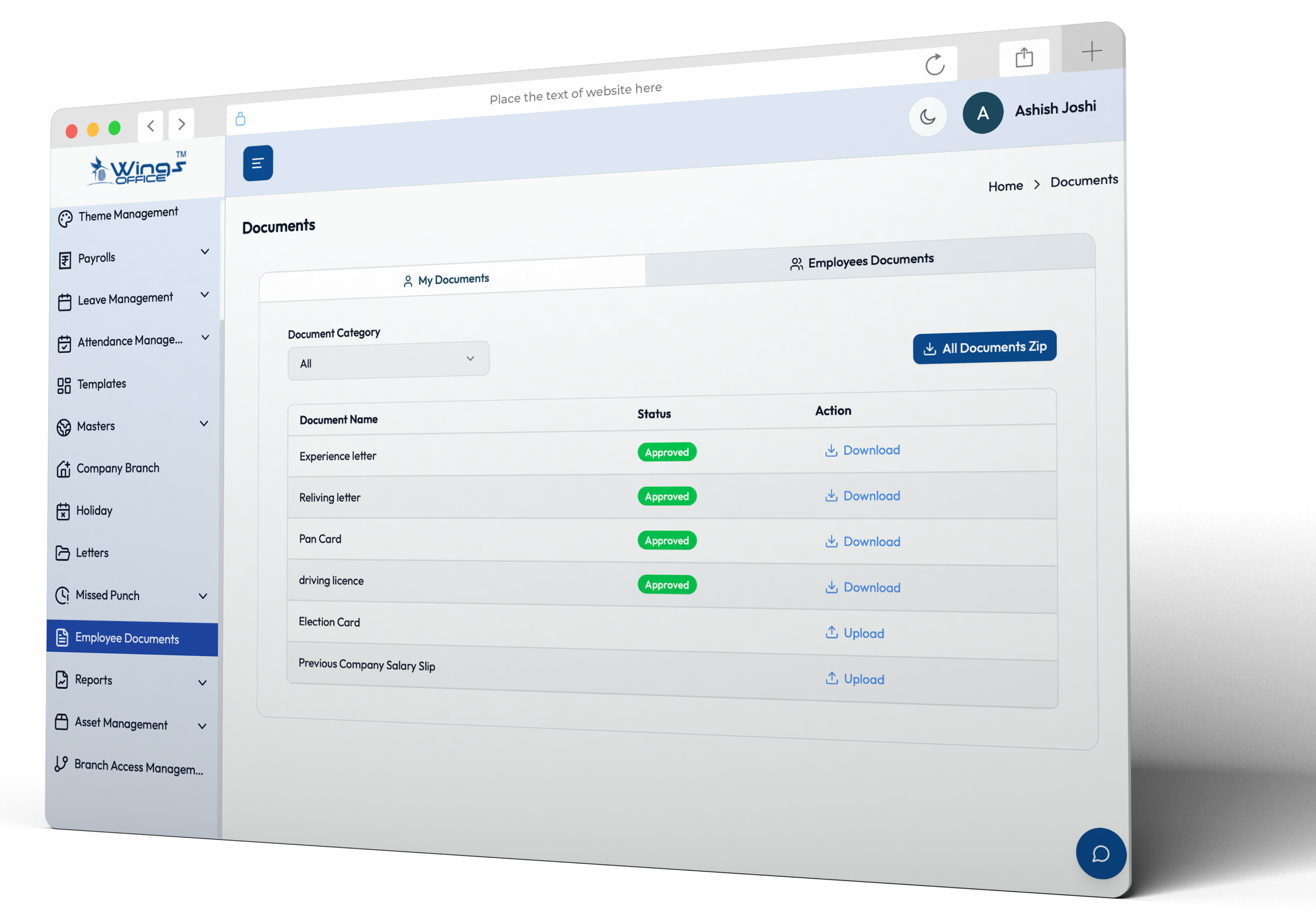
Every Employee's Document, Instantly Accessible
Digital Document
Management At One-Place

Employee Self-Upload
Employees upload their own documents—ID proofs, certificates, and bank details. No more chasing employees for paperwork. They do it from their portal.

HR Verification
HR reviews uploaded documents, verifies authenticity, and marks them as verified. Unverified documents are flagged for follow-up.

Expiry Alerts
Set expiry dates for documents like health insurance, driving licenses, and contracts. WingsOffice sends automatic reminders before expiry.

Organized Categories
Documents organized by category identity proofs, education, employment, financial, medical. Custom categories available for your company’s needs.

Secure Storage
All documents are encrypted at rest and in transit. Role-based access ensures only authorized personnel can view sensitive documents.

Compliance Dashboard
Track document completion rates across the organization. Identify employees with missing or expired documents at a glance.
Frequently Asked Questions
Common Questions
Most modern document management systems support a wide range of file formats, including PDF, DOC, DOCX, XLS, XLSX, PPT, PPTX, JPG, PNG, and other commonly used business documents. This flexibility enables organizations to securely store, manage, and access employee records and operational documents from a centralized platform.
A document management system helps small businesses organize, store, and retrieve important files efficiently while reducing paperwork and manual record handling. Features such as secure access controls, document categorization, and cloud-based storage improve productivity and ensure business information remains accessible and protected.
An employee record management system enables SMEs to maintain employee profiles, contracts, certifications, identity documents, and HR records in a centralized digital repository. This improves data accuracy, simplifies compliance management, and allows HR teams to access employee information quickly whenever needed.
Yes, most HRMS and document management platforms allow administrators to designate specific documents as mandatory during onboarding or employment. This helps organizations ensure employees submit required records such as identification, tax documents, contracts, and compliance-related paperwork on time.
No, employee documents are typically protected through role-based access controls and permission settings. Employees can generally view only their own documents, while authorized HR personnel and administrators can access records based on their assigned responsibilities, ensuring privacy and data security.